
No matching pages. Try "pallet", "mezzanine" or "cantilever".
Choosing the right Double Deep Pallet Racking system can reshape warehouse capacity, access, and daily safety. For global buyers, the decision involves more than comparing prices or steel thickness. Storage loads, forklift reach, pallet dimensions, seismic conditions, and local installation practices all influence performance. Space is expensive. Mistakes are more expensive.
This guide presents seven practical tips for evaluating suppliers and planning a dependable system. It explains how to verify load ratings, inspect beam and frame quality, assess forklift compatibility, and protect pallet access. It also considers aisle layout, corrosion resistance, installation support, and long-term maintenance. These details come from common warehouse planning challenges, where a few centimeters can affect truck clearance and every loading cycle.
Reliable purchasing requires evidence, not attractive photographs. Ask for engineering documents, product specifications, test information, and references from comparable facilities. Confirm whether the quoted capacity applies to each level, each bay, or the complete structure. That distinction matters. Buyers should also review communication quality, replacement-part availability, and after-sales support before placing an international order.
Some recommendations may seem obvious, yet they are often overlooked under schedule pressure. Measure twice. Confirm everything in writing. A supplier may offer an efficient design, but the design still needs independent review by qualified professionals familiar with the site. This article is not a substitute for local engineering assessment. It is a practical starting point for making clearer, safer, and more informed Double Deep Pallet Racking decisions across global supply chains.
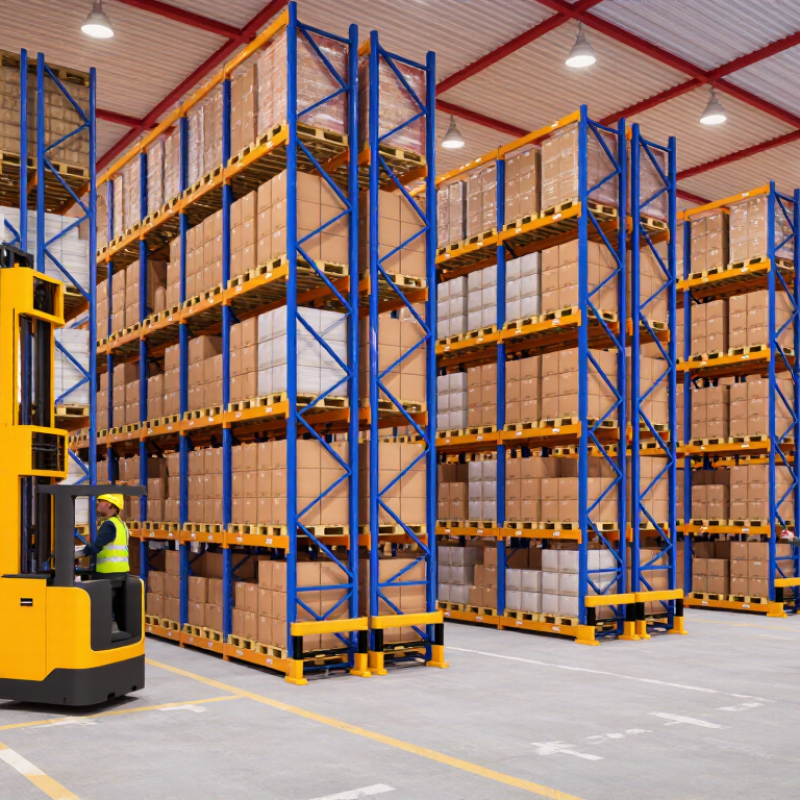
Double deep pallet racking places two pallets behind each other in one storage lane. A reach truck with telescopic forks accesses the rear position through the front position. This arrangement reduces aisle space and increases pallet density. It works best when many pallets share similar products, dimensions, and turnover rates.
Its core principle is controlled access, not maximum height alone. Double deep storage usually follows a last-in, first-out pattern. Therefore, it suits stable goods with moderate rotation better than strict first-in, first-out inventory. Rack depth, beam capacity, pallet condition, and forklift reach must match. Floor flatness also matters. A small level error can become a serious alignment problem at upper levels. The system is efficient, but it is not a perfect answer.
Tips: Confirm pallet sizes before design. Leave enough clearance for safe fork entry. Mark each lane clearly. Train operators to place rear pallets gently, because hidden damage is easy to miss. Inspect frames, beams, and guide rails regularly. Do not assume every standard pallet behaves the same. In practice, mixed loads often reduce the expected storage gain. A trial bay can reveal handling problems before full installation. Suppliers should provide load calculations, layout drawings, and inspection guidance based on the actual warehouse conditions.
Double-deep pallet racking needs more than extra storage depth. Global buyers should inspect the warehouse before selecting a frame system. Measure clear height, aisle width, floor flatness, column positions, doors, sprinklers, and emergency routes. Mark every obstruction on the layout. Measure twice.
A practical layout should match real pallet movement, not only a computer drawing. Keep enough space for pallet overhang and safe retrieval. Consider whether operators can see rear positions clearly. A dense design may increase capacity, but it can slow picking and create awkward travel paths. I have seen attractive layouts fail because the receiving area became congested. That weakness is easy to miss during planning.
Load data must be specific. Record pallet dimensions, gross weight, load center, stacking method, and the number of levels. Do not rely on average pallet weights. Check beam capacity, upright capacity, and total bay loading with a qualified engineer. Also inspect the floor slab and anchor requirements. Forklift compatibility matters just as much. Confirm lift height, mast clearance, reach depth, turning radius, aisle width, and rated capacity at the working height. The truck must reach the rear pallet without striking the frame. Test with a loaded pallet when possible. A theoretical match may still feel unsafe in daily operation. Recheck assumptions after a trial run.
7 Double Deep Pallet Racking Tips for Global Buyers
Double deep pallet racking needs accurate measurements before any quotation or installation. Measure pallet length, width, height, and actual load weight. Add clearance for beam deflection, forklift movement, and fire protection requirements. A rack that fits the drawing may still restrict daily operations. Leave practical aisle space, not only the minimum calculated width. Local building conditions can also affect upright height and anchoring choices.
Tip: Match each beam level to the stored load, not just the pallet count. Lower levels may hold heavier goods, while upper levels often need lighter, stable loads. Confirm beam span, deflection limits, and connector security with qualified engineers. Mixed pallet sizes create problems quickly. Adjustable levels help, but excessive flexibility may reduce capacity and complicate inspections.
Tip: Select pallet access configurations around your handling equipment. Double deep layouts usually need reach trucks with suitable fork extension and lifting capacity. Check the deepest pallet first. It must be retrieved without striking the front pallet or rear frame. Consider load rotation, stock frequency, and first-in, first-out needs. Double deep storage can save floor space, yet it may slow access. That trade-off is easy to underestimate. Use clear location labels and routine inspections to reduce picking errors. A small design compromise is acceptable only when documented and reviewed.
Choose rack dimensions, beam levels, and pallet access configurations based on pallet size, handling equipment, aisle requirements, and storage density.
The chart shows indicative planning midpoints in metres. Actual aisle width depends on forklift turning radius, load size, mast height, floor conditions, and local safety requirements.
7 Double Deep Pallet Racking Tips for Global Buyers
Double deep racking needs verified engineering, not attractive drawings. Tip 1: Request calculations for load capacity, beam deflection, seismic forces, and floor strength. Tip 2: Confirm compliance with recognised standards, such as EN 15629, EN 15635, or ANSI MH16.1. Local fire and building rules still apply. The 2023 U.S. Bureau of Labor Statistics Census recorded 5,283 fatal occupational injuries. This figure is not rack-specific, but it reinforces the cost of weak warehouse controls.
Tip 3: Check steel certificates, weld quality, coating thickness, and component traceability. Tip 4: Require trained installers and a documented handover inspection. Uprights must stand plumb. Anchors must match the approved design. Tip 5: Inspect guide rails, pallets, and forklifts together. A small pallet overhang can become a repeated impact point. I have seen clean-looking racks hide damaged baseplates. Appearance is not proof. Tip 6: Plan inspections after installation, after relocation, and after any collision. EN 15635 recommends regular visual inspections and recorded corrective actions. Photos help, but written repair deadlines matter more.
Tip 7: Evaluate long-term durability through corrosion resistance, replaceable guards, spare-part access, and operator training. Ask for realistic service-life assumptions, not vague promises. One detail deserves more thought: the highest capacity is not always the safest choice. Leave operational clearance for uneven loads and changing inventory. A cheaper frame may cost more after repeated repairs. Uncertainty should be recorded before purchase, not discovered under load.
| No. | Buyer Tip | What to Verify | Practical Benchmark or Requirement | Required Documentation or Inspection | Long-Term Risk Controlled |
|---|---|---|---|---|---|
| 1 | Confirm the applicable safety standard | Check whether the design and use instructions comply with the regulations applicable at the installation location. | Common references include EN 15635 for steel static storage systems and ANSI/RMI MH16.1 for industrial steel storage racks. Local building, seismic, fire, and occupational-safety rules may also apply. | Signed design calculations, rack layout, load notices, standard-compliance statement, and local code review where required. | Overloading, unsuitable design assumptions, regulatory non-compliance, and avoidable structural failure. |
| 2 | Match the rack to the pallet and load | Verify pallet length, width, height, weight, load distribution, overhang, and the number of pallets stored back-to-back. | Every beam level must have a clearly stated uniformly distributed load and the design must account for the combined load of two pallet positions in double-deep storage. | Approved pallet profile, load test or load data, beam-capacity chart, and a signed configuration drawing showing clearances. | Pallet instability, beam deflection, blocked access, product damage, and unsafe forklift handling. |
| 3 | Check the double-deep access method | Confirm that the reach truck or other handling equipment can safely place and retrieve the rear pallet without striking the frame or front load. | Validate lift height, residual capacity at reach, aisle width, turning radius, mast visibility, and the required front-to-rear pallet clearance using the actual truck model. | Equipment specification sheet, aisle simulation or site trial, operating procedure, and documented clearance measurements. | Collision damage, dropped loads, inefficient retrieval, and reduced storage utilization. |
| 4 | Inspect installation quality | Review frame plumbness, anchor installation, beam engagement, bracing, aisle alignment, and floor condition. | Anchors, base plates, frame alignment, beam locks, and bracing must follow the approved engineering drawings and the applicable installation standard; do not accept unapproved field modifications. | Installation checklist, torque or anchoring records where specified, as-built measurements, photographs, and completion sign-off by a qualified installer. | Progressive misalignment, loose connections, anchor failure, and reduced load-carrying capacity. |
| 5 | Specify impact protection | Identify exposure points for forklifts, including end frames, aisle-facing uprights, corners, and areas with frequent truck movement. | Use properly anchored guards or barriers designed for the expected vehicle impact environment, while maintaining required aisle and pallet clearances. | Protection layout, anchoring details, impact-protection specifications, and documented damage-reporting and replacement procedures. | Bent uprights, damaged anchors, repeated repairs, and hidden structural weakness after vehicle contact. |
| 6 | Evaluate corrosion protection and material quality | Assess steel grade, coating system, weld quality, surface preparation, and suitability for humidity, temperature variation, or cold-storage conditions. | The coating specification should match the environment. Inspect for continuous coverage, damaged areas, sharp edges, weld defects, and premature rust before shipment and after installation. | Material certificates, coating or paint specification, production inspection records, weld inspection records where required, and pre-shipment photographs. | Corrosion-related section loss, coating failure, hygiene problems, and shortened service life. |
| 7 | Plan inspection, maintenance, and spare parts | Ensure the warehouse can identify damage, isolate unsafe bays, report incidents, and obtain compatible replacement components. | Use routine user checks, formal inspections at intervals defined by the applicable safety program, and immediate reporting of serious damage or displacement. | Inspection schedule, damage log, rack identification labels, repair procedure, spare-parts list, and training records for warehouse personnel. | Unreported damage, repeated downtime, incompatible repairs, and gradual loss of structural reliability. |
Note: Capacity, clearances, anchoring, seismic requirements, and inspection intervals must be confirmed for the specific site, pallet profile, handling equipment, building conditions, and applicable local regulations.
7 Double Deep Pallet Racking Tips for Global Buyers
Supplier comparisons should start with cost per usable pallet position, not the lowest quotation. Request itemized pricing for frames, beams, rails, safety barriers, installation, freight, and inspection. The MHI 2024 Annual Industry Report found that 55% of surveyed supply-chain professionals plan to increase technology investment. That pressure makes storage density valuable, but double deep racks also require compatible forklifts and disciplined inventory control. Ask suppliers for load calculations, testing records, engineering drawings, and references from similar climates.
Customization affects both safety and operating cost. Confirm pallet dimensions, load weight, aisle width, floor strength, seismic exposure, corrosion risks, and forklift reach before approving a design. A rack that fits the building may still waste labor if operators cannot access rear pallets efficiently. Compare delivery schedules, replacement-part availability, and installation training across regions. Small details matter.
After-sales support needs measurable terms. Look for inspection intervals, response times, spare-part stock, warranty limits, and documented repair procedures. ISO 9001 certification can support process reliability, but it does not replace independent engineering review. MHI’s report also highlights continuing investment in supply-chain resilience, yet a rack system itself cannot remove every operational weakness. I have seen buyers overvalue initial savings. That mistake can become expensive. Include annual inspection costs and possible downtime in the total-cost model.
Measure clear height, aisle width, floor flatness, doors, columns, sprinklers, and emergency routes. Mark every obstruction. Measure twice.
Record pallet length, width, height, gross weight, load center, and stacking method. Do not use average weights. Real loads vary.
Check lift height, mast clearance, reach depth, turning radius, aisle width, and working-height capacity. Test with a loaded pallet when possible. Theory can mislead.
It can save floor space but may slow retrieval and create awkward travel paths. Rear pallets need clear access. Density has a cost.
Match each beam level to the actual load, not only the pallet count. Lower levels may hold heavier goods. Upper levels need stable loads.
Confirm pallet dimensions and use adjustable levels carefully. Too much flexibility may reduce capacity and complicate inspections. Keep locations clearly labeled.
Compare cost per usable pallet position, not only the lowest quotation. Request itemized prices for frames, beams, barriers, installation, freight, and inspection. Cheap can become expensive.
Confirm inspection intervals, response times, spare-part availability, warranty limits, and repair procedures. Include downtime and annual inspections in total costs. Do not overlook support.
Double Deep Pallet Racking is a high-density storage solution that places pallets two positions deep, helping warehouses increase capacity while maintaining organized inventory access. Global buyers should first evaluate warehouse dimensions, aisle space, ceiling height, pallet size, load weight, and inventory turnover. Forklift reach, lifting capacity, maneuverability, and operator visibility are equally important, since the system requires equipment capable of safely accessing both pallet positions.
When selecting a configuration, buyers should compare rack depth, frame height, beam levels, pallet entry direction, and first-in, first-out or last-in, first-out access needs. Safety should remain a priority: verify structural calculations, load ratings, anchoring, installation procedures, inspection routines, and resistance to long-term wear. Finally, compare suppliers by total cost rather than purchase price alone, including customization, shipping, installation, replacement parts, technical support, warranties, and after-sales service. A careful evaluation ensures that Double Deep Pallet Racking delivers reliable storage density, operational efficiency, and lasting value.