Continuous Support Rails
Pallets rest on continuous cold-formed galvanized angle tracks supported by heavy-duty welded or bolted cantilever brackets, removing the cross-beams of selective systems.

No matching pages. Try "pallet", "mezzanine" or "cantilever".
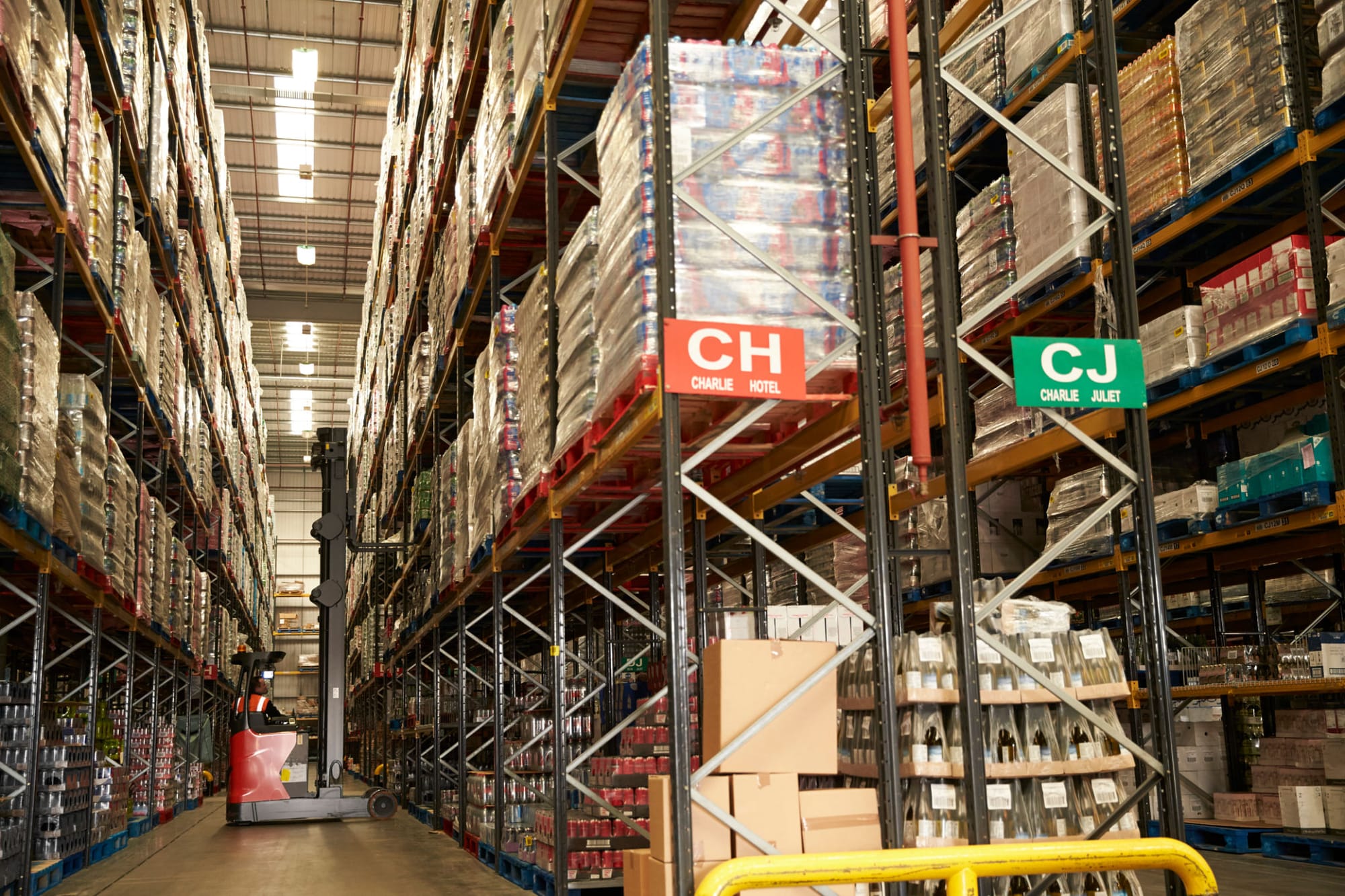
Industrial warehousing space across international hubs, free zones, and urban logistics corridors faces escalating rental costs and strict land limits. When storing hundreds of identical pallets per SKU, conventional wide-aisle selective layouts waste up to 60% of warehouse volume on forklift transit pathways. Drive-In Racking Systems eliminate operational access aisles entirely, transforming dead vertical space into uninterrupted cubic density.
Achieve unmatched storage density per square metre by eliminating intermediate service aisles.
Consolidate chilled air volumes in cold rooms to curb ongoing cooling power consumption by 35%.
Calculated structural capacity adhering to European steel racking codes and local Civil Defence guidelines.
Full project lifecycle oversight: site laser scanning, CAD layout, supply, certified erection, and handover.
As global distribution operations optimize capital expenditure, warehouse logistics engineers face a universal challenge: How do we double pallet capacity within our current building envelope without sacrificing operational safety?
Drive-In Racking Systems represent the premier compact storage methodology for homogeneous, high-volume inventory. By permitting standard lift trucks to drive directly into structural storage lanes, materials are placed on continuous cantilevered side rails. This guide details structural principles, LIFO vs. FIFO economics, pallet dimensional clearances, cold storage dynamics, and safety retrofits engineered by GENEX Racking Solutions UAE.
Understanding the mechanical interplay between upright profile gauge, cantilever bracket moment limits, and dynamic forklift wheel interaction inside high-density storage tunnels.
Pallets rest on continuous cold-formed galvanized angle tracks supported by heavy-duty welded or bolted cantilever brackets, removing the cross-beams of selective systems.
Because the front bays remain open for forklift access, frame rigidity is engineered via horizontal roof bracing trusses, rear vertical diagonal ties, and ground anchors.
Configured as single-entry Drive-In (LIFO) against warehouse perimeter walls, or double-entry Drive-Through (FIFO) to link manufacturing batches directly to dispatch lanes.
Continuous floor-anchored steel guide rails steer forklift wheels safely down narrow lanes, shielding vertical upright columns from vehicle impact.
Selecting the right warehouse layout demands a calculated balance between pallet access, capital expenditure (CapEx), SKU variation, and cycle times. Evaluate key engineering indicators across storage types:
| Racking Methodology | Storage Density | Pallet Selectivity | Rotation Logic | CapEx per Pallet | Target SKU Profile |
|---|---|---|---|---|---|
| Drive-In Racking | 80% – 85% | Lane-Dependent | LIFO | Economical / Low | Few SKUs, High Volume, Cold Storage |
| Drive-Through Racking | 75% – 80% | Lane-Dependent | FIFO | Moderate | High Batch Volume, Buffer Shipping |
| Radio Shuttle System | 85% – 90% | Channel Automated | LIFO / FIFO | High (Cart + Rails) | Mega Cold Stores, High Throughput |
| Double Deep Racking | 60% – 65% | 50% Direct Access | LIFO | Economical | Medium SKU Variety, 2-4 Pallets/SKU |
| Selective Pallet Racking | 35% – 45% | 100% Direct Access | Any | Baseline Minimum | Broad Assortment, 3PL Warehouses |
| Gravity Pallet Flow | 75% – 85% | Lane Picking Face | FIFO | High (Roller Beds) | Short Shelf-Life, Perishable FMCG |
Structural analysis must account for floor slab flatness (DIN 18202 or TR34), forklift mast height under load, and local civil defense sprinkler regulations before system selection.
Because forklift trucks enter deep inside the racking frame, drive-in systems face continuous operational contact risks. GENEX engineers every installation with multi-layered protective hardware to ensure structural stability over decades of service.
Heavy structural steel angle tracks (typically 100x75x8mm or 120x80x8mm) are anchored to the floor slab, guiding forklift wheels smoothly down lanes and protecting uprights from side collisions.
Formed one-piece galvanized pallet rails feature flared entry horns and raised outer guide stops, ensuring pallets center smoothly on rails without snags or load imbalances.
Front-entry uprights bear high turning forces. GENEX fits wrapped heavy steel post guards, reinforced double-column uprights, and heavy-duty floor baseplates with multi-point expansion anchor bolts.
Integrated backstops prevent pallets from shifting off track, while overhead horizontal clearance portals safeguard building infrastructure and top-tier sprinkler lines.
Purchasing directors and warehouse engineers must look beyond traditional static steelwork. Emerging operational trends are reshaping high-density racking specifications worldwide:
Modern operators choose convertible drive-in structures with adjustable brackets. This enables a quick upgrade from manual forklift entry to semi-automated 2D Radio Pallet Shuttles as SKU throughput increases, protecting initial capital investments.
With industrial refrigeration power costs rising, drive-in systems are configured up to 12 metres high. Packing pallet blocks tightly minimizes ambient cubic volume, slashing freezer kWh usage by 25% to 40% compared to selective racking.
Industrial IoT impact sensors installed on critical front-entry uprights track operational knocks in real time. Fleet management systems capture incident timestamps, streamlining compliance audits under EN 15635 standards.
Switching from wet-spray paint finishes to pre-galvanized high-yield micro-alloy steel enhances corrosion resistance in humid coastal regions, chilled distribution units, and chemical storage hubs.
Modern procurement requires 3D finite element analysis (FEA) accounting for floor slab joint flexure, dynamic wind loads in semi-open sheds, and regional seismic zone codes across global projects.
Automated Guided Forklifts require precise drive-in entry alignments. Modern lanes feature laser-reflective targets, flared channel shoes, and tighter manufacturing tolerances to accommodate autonomous navigation.
GENEX Racking Solutions UAE delivers turnkey industrial storage systems, blending field expertise with rigorous structural engineering across the Emirates and global logistics networks.
Every layout is tailored to your pallet weights, clear building height, forklift turning radiuses, and structural column grid—never pulled from a generic catalogue.
Uprights, cantilever brackets, and continuous guide tracks are formed from certified structural steels, thoroughly tested and labeled with visible load rating plaques.
Full-time, factory-trained installation crews assemble, plumb, level, and secure your systems with torque-calibrated anchor fixings and mandatory Civil Defence egress clearances.
We provide ongoing structural health inspections under EN 15635 standards, offering rapid repairs, upright realignments, and certified replacement parts to keep operations compliant.
Practical engineering details honed across hundreds of complex installations that protect inventory, vehicles, and warehouse teams.
Drive-in systems hold pallets along their outer edges without center shelf beams. Soft, damaged, or low-spec disposable pallets can sag under heavy loads. Always verify timber or plastic pallet deflection ratings before commissioning deep lanes.
Forklift masts naturally lean back during travel. When designing upper tier rail clearances, calculate overall truck width across the carriage and include mirror, cab guard, and tilt tolerances—not just the fork blade span.
High-density drive-in frames impart concentrated point loads through baseplates. If anchor bolts hit expansion joints in the concrete floor, anchor pull-out ratings fall dramatically. We survey all joint locations before drilling floor anchors.
Overseas project directors and supply chain managers can fast-track concept design and structural quotations by providing these six core project parameters upfront:
Length, width, total height, load overhang on sides, and maximum gross weight per pallet (e.g. Euro 1200x800mm or ISO 1200x1000mm).
Chassis width, overall mast collapsed/extended height, overhead guard dimensions, and required operating turning radius.
True clear height measured from the finished floor to the lowest obstacle—such as fire sprinkler pipes, lighting fixtures, or roof trusses.
Concrete slab thickness, reinforcement layout, compressive strength (e.g. C25/30), and positions of expansion joints.
Total pallet count per SKU, batch sizes, daily dispatch frequency, and target lane depth (typically 3 to 10 pallets deep).
Operating temperature (ambient, chilled, or -25°C blast freezer) along with local Civil Defence and fire sprinkler system requirements.
Direct answers to the top engineering, operational, and financial questions buyers ask about high-density drive-in systems.
Drive-In Racking is best suited for facilities with low SKU counts and large volumes per SKU (typically 10 to 30+ pallets per SKU minimum). By allowing counterbalanced or reach trucks to drive straight into deep storage bays, it eliminates intermediate aisles. This increases cubic storage volume by 60% to 85% compared to selective racking. For operations handling high SKU variety where every pallet requires immediate, direct access, selective racking remains the better choice.
Drive-In systems use a single access aisle for loading and unloading on a Last-In, First-Out (LIFO) sequence, stabilized by full diagonal cross-bracing along the rear back frame. Drive-Through systems allow forklift entry from both ends, enabling First-In, First-Out (FIFO) stock rotation. However, because rear bracing is omitted to permit pass-through travel, drive-through layouts require heavy-duty overhead and mid-level structural tie-beams to maintain stability.
Sub-zero cold storage carries high ongoing energy costs per cubic metre. Conventional selective layouts leave substantial aisle volumes that must be continuously chilled. Drive-in systems pack pallet loads tightly together, reducing dead air gaps and maximizing cold thermal mass. This compact configuration cuts refrigeration power consumption per pallet position by 30% to 45%.
From a purely structural perspective, lanes can be engineered up to 10–12 pallets deep. However, from an operational and cycle-time standpoint, GENEX recommends 4 to 7 pallets deep for manual forklift operations. Lanes deeper than 7 pallets increase truck travel time and raise the risk of accidental frame impact during reversing. When storage depths of 10 to 25 pallets are needed, migrating to an automated Radio Pallet Shuttle system is the safer, faster solution.
Yes, standard counterbalance trucks and reach trucks can be used, provided their outer chassis and overhead guard widths fit within the clear lane dimension with at least 75mm–100mm of side clearance. Forklift masts must maintain clearance without catching on upper pallet rails. For smooth operation and upright protection, GENEX installs floor-anchored steel guide rails to keep trucks centered down the lane.
Yes, provided the frame profiles and bracket pitch are pre-engineered for future upgrade tolerances. GENEX offers hybrid-ready lane designs, allowing warehouse operators to swap static cantilever rails for automated pallet shuttle tracks later on. This future-proof design enables a smooth transition to higher automation as throughput demands grow.
Send our applications engineering team your facility layout, pallet load profiles, and forklift specs. We will deliver an optimized CAD layout, cubic volume analysis, and an itemized structural quotation.