ISO 9001 / CE / EN 15512 Certified Factory Direct

China Best Heavy Duty Racking Supplier & Suppliers

Pioneering precision structural steel manufacturing, cold-rolled roll forming engineering, and automated high-bay warehouse racking solutions with verified load-bearing performance and comprehensive global shipping capabilities.

50,000+
Metric Tons Annual Output
Q355B
High-Tensile Structural Steel
100%
Deflection & FEA Verified
85+
Countries Global Installation
Engineered Storage Solutions

High-Performance Heavy Duty Racking Systems

Our verified industrial product lines combine computerized cold-roll profiling with heavy-gauge hot-rolled structural durability. Explore our 8 flagship heavy-duty storage configurations engineered for optimal pallet volume, seismic stability, and maximum spatial cubing.

Industry White Paper

Structural Mechanics & Quality Engineering of Heavy Duty Racks

Selecting a certified heavy-duty warehouse racking supplier from China requires technical due diligence beyond surface-level quotes. Understanding metallurgical yields, finite element structural deflection (FEM 10.2.02), and roll-forming tolerances is crucial to operational life safety.

Cold-Formed Continuous Profiling vs. Fabricated Hot Sections

Modern industrial racking relies on high-yield, cold-formed structural steel profiles. While traditional light fabrication relies on welded commercial angles, high-capacity upright frames are formed through continuous CNC multi-stage cold-roll-forming lines. This precision process preserves the molecular grain boundary of the steel, introducing continuous work hardening at critical bend radii to increase yield strength by up to 18%.

At our China manufacturing base, prime structural coils of grade Q235B (yield strength ≥ 235 MPa) and Q355B (yield strength ≥ 355 MPa) are calibrated within continuous roll stations. This creates an engineered Omega (Ω) profile featuring 11 to 13 structural bends per upright, providing superior torsional rigidity and elastic moment resistance compared to standard tubular channels.

"Under international standard EN 15512, rack stability hinges upon connection rotational stiffness and floor anchor shear capacity. The integration of 4-claw cold-stamped beam connectors reduces beam-to-column joint slippage by over 42% compared to standard bolt configurations."

Deflection Limits, Safety Multipliers, and Seismic Integrity

A common failure in sub-standard racking occurs when dynamic beam deflection exceeds permissible structural limits. Engineering compliance under FEM 10.2.02 and RMI (Rack Manufacturers Institute) mandates that maximum vertical deflection under safe working load (SWL) must strictly adhere to:

Deflection Limit: δ ≤ L / 200 (up to L / 300 for sensitive AS/RS installations)
Structural Safety Factor: γm = 1.4 to 1.65 (Steel Yield Verification)
Seismic Ductility Factor: q ≥ 1.5 - 2.0 (Equivalent Static Lateral Analysis)

Every racking installation engineered by our design team is subjected to simulated 3D FEA (Finite Element Analysis) stress modeling. We evaluate dead load, live pallet payload, seismic acceleration forces (PGA values up to 0.4g), and forklift impact energy absorption (minimum 400 J rated base protectors) to eliminate the risk of progressive structural collapse.
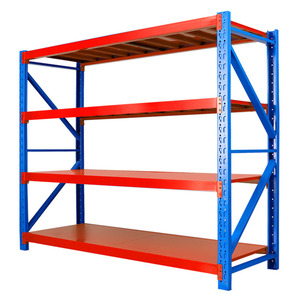
Certified Anti-Corrosion Finishing

Automated 7-stage chemical pre-treatment (degreasing, phosphating, pure water rinse) paired with thermosetting electrostatic epoxy powder coating (60-90μm thickness) delivers 500+ hours of ASTM B117 salt-spray corrosion resistance.

Computerized CNC Hole Pitching

Continuous hydraulic stamping ensures hole positioning tolerances within ±0.1mm across the entire 12-meter continuous vertical upright length, guaranteeing swift beam level adjustability and rigid safety locking pin engagement.

Automated Storage Interface Ready

Machined upright datum notches and ground rail tolerance profiles interface with automated storage and retrieval systems (AS/RS), stacker cranes, and 4-way autonomous shuttles without structural deflection interference.

Strategic Forecasting

Future Procurement Trends in Heavy-Duty Warehouse Storage

Global supply chain resilience, escalating industrial land values, and autonomous intralogistics are reshaping capital procurement decisions. Logistics directors and global procurement managers must evaluate suppliers against these 4 transformative industry shifts.

TREND 01 • 2025-2027

Shuttle & AS/RS Hybridization

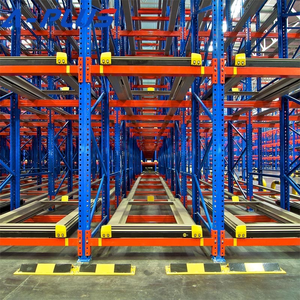
Pure selective static racking is being rapidly replaced by high-density automated shuttle architectures. Procurement demand for roll-formed tracks integrated into deep-lane push-back or pallet runner rails has surged by 45% year-over-year. Buyers require suppliers whose cold-rolled profiles meet tight manufacturing tolerances of ±0.5mm per 3-meter section to prevent autonomous shuttle derailment.

TREND 02 • 2025-2028

High-Tensile Thin-Walling Engineering

Escalating maritime freight rates and containerized shipping overheads have made structural weight optimization paramount. Using ultra-high-strength micro-alloyed steel (such as Q355B and Q460), modern Chinese manufacturers can reduce profile cross-sectional thickness by 12-15% while delivering identical safe working load capacities, cutting landed freight costs per pallet location significantly.

TREND 03 • 2026-2029

Structural Digital Twins & Dynamic Sensors

Warehouse managers are specifying sensor-ready racking assemblies. Upright bases pre-machined to accommodate digital strain gauges, dynamic load cells, and laser deflection telemetry provide live structural capacity reporting. This live integration enables real-time compliance with EN 15635 rack safety inspections, alerting teams before hazardous structural overload occurs.

TREND 04 • 2026-2030

Closed-Loop ESG & Traceable Decarbonization

International corporate tenders increasingly mandate Environmental Product Declarations (EPDs). China's leading racking manufacturers now utilize electric arc furnace (EAF) low-carbon steel, solvent-free closed-loop powder recovery systems (with 98% powder reuse efficiency), and 100% recyclable structural framing to assist clients in achieving Scope 3 net-zero operational milestones.

Procurement Engineering Matrix

Comprehensive Structural Selection & Operational Comparison

Selecting the ideal racking architecture requires balancing inventory selectivity, spatial density, forklift equipment costs, and inventory rotation rules. Use this engineering comparison matrix to align your warehouse layout with your material handling equipment.

Racking Architecture Space Utilization Pallet Selectivity Stock Rotation Typical Payload / Level Handling Equipment Required Relative Capex
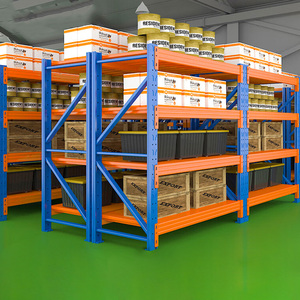
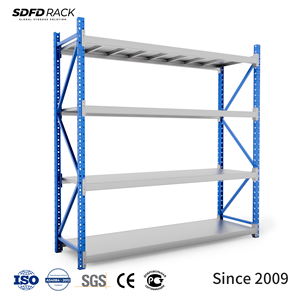
Selective Pallet Racking Standard (35% - 40%) 100% Immediate FIFO / LIFO 1,000 - 4,000 kg Counterbalance, Reach Truck Low / Baseline
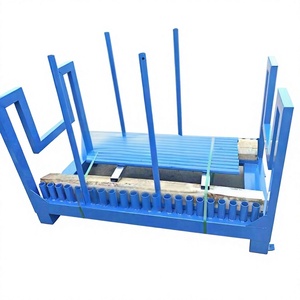
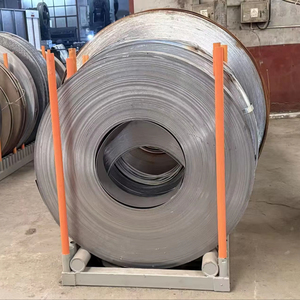
Heavy Duty Coil Cradles Dense Custom 100% Direct Direct Access 5,000 - 25,000 kg Heavy Crane, Coil Stacker Truck Medium
Push-Back Cart Racking High (65% - 70%) Lane Facing (~25%) LIFO 1,000 - 1,500 kg Standard Forklift Medium-High
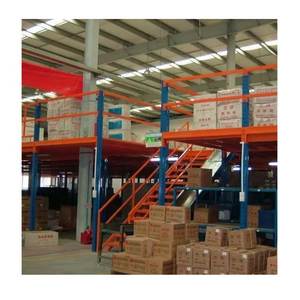
Multi-Tier Mezzanine Platform Ultra-High (200%-300%) 100% Hand Pick Continuous 300 - 1,000 kg / sqm Pedestrian, Goods Lift, Conveyor Medium-High
Drive-In / Drive-Through Maximum Static (75%+) Low (Lane-based) LIFO (or FIFO) 1,000 - 2,000 kg Narrow Counterbalance Medium
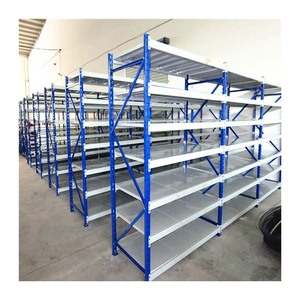
Long-Span E-Commerce Shelving Medium-High 100% Manual Pick Manual Access 200 - 800 kg Manual Cart, Order Picker Low

Note: Actual bay loads and column gauge sizing are calculated dynamically based on structural beam span, upright frame height, anchor embedment depth, and local seismic acceleration parameters.

Enterprise Strengths

Why International Buyers Trust Our China Manufacturing Facilities

As an established engineering designer and high-capacity manufacturer of heavy-duty industrial storage racks, we bridge high-volume China factory production with stringent international structural codes.

Full In-House CAD & Structural FEA

Our structural engineering department develops complete warehouse layout drawings in AutoCAD, Navisworks 3D, and SolidWorks. We calculate dead loads, beam deflection ratios, and seismic forces specifically adapted to your forklift turning radius and slab design.

Rigorous International Certifications

All production runs adhere strictly to ISO 9001:2015 quality controls and European CE standards. Uprights and beam connectors are routinely batch-tested to EN 15512, ensuring documented yield strengths, safety margins, and structural compliance.

Turnkey OEM & ODM Custom Fabrication

We accommodate custom industrial geometries including heavy steel coil cradles, automotive component racks, outdoor hot-dip galvanized cantilever towers, and multi-tier structural mezzanine picking floors tailored to unique operational requirements.

Comprehensive Safety Accessories

Every project includes crucial structural safety options: laser-cut heavy upright column guards, end-of-aisle wrap-around barriers, mesh wire decking with welded support channels, drop-in pallet back-stops, and stamped load capacity plaques.

Container-Optimized Export Packaging

Our dedicated logistics packing teams utilize heavy steel skids, multi-layer bubble wrap, protective edge protectors, and precision bundling to prevent shipping abrasion and maximize container cubic space, lowering landed shipping expenses per unit.

Global Erection Supervision & Support

We provide exhaustive 3D installation blueprints, step-by-step video manuals, and on-site engineering supervision teams across international destinations to ensure your heavy racking array is plumbed, leveled, and anchored to standard tolerances.

Clear Technical Guidance

Frequently Asked Questions: Heavy Duty Racking Procurement

Key technical answers for procurement directors, logistics engineers, and warehouse operations teams sourcing commercial and industrial pallet racking systems from China.

What steel grades and mill certifications are provided for heavy-duty upright frames?
We exclusively procure certified prime structural steel coils directly from domestic Tier-1 state steel mills (such as Baosteel, Ansteel, and Shougang). Our standard heavy-duty uprights utilize Q235B (yield strength ≥ 235 N/mm²) and Q355B (yield strength ≥ 355 N/mm², equivalent to European S355JR and ASTM A572 Grade 50). Every container shipment is accompanied by verified EN 10204 3.1 Mill Test Certificates (MTC) detailing carbon equivalency, chemical composition, and tensile/yield stress test results.
How are beam load capacities calculated, and what safety factor is utilized?
Beam load ratings assume a pair of beams uniformly loaded with two or three standard pallets. In compliance with European standard EN 15512 and FEM 10.2.02, beam deflection under maximum working load is constrained to ≤ L/200 (or L/300 for specialized automated systems), with a minimum material safety factor of γm = 1.65 against elastic failure. Furthermore, all beam-to-column connector claws include automatic steel spring safety pins that withstand a minimum upward shearing force of 5 kN per connection to prevent accidental displacement during forklift disengagement.
What warehouse slab specifications are required prior to anchoring heavy racking?
For standard heavy-duty selective installations up to 8 meters in height, concrete slabs should possess a minimum compressive strength of 20 to 25 MPa (C20/25 or 3,000 PSI) and a crack-free slab thickness of not less than 150mm - 200mm. For high-bay installations exceeding 10 meters or heavy coil platforms, high-strength concrete of 30+ MPa (C30/37) with engineered rebar mesh is required. Floor flatness must adhere to DIN 18202 Table 3 or TR34 FM2 specifications to prevent mast leaning at height. Each upright base plate is fastened using M12 to M16 heavy-duty wedge mechanical anchors or chemical expansion anchors embedded 90mm to 140mm deep.
What are the key technical differences between Push-Back racking and Drive-In racking?
While both systems provide high-density LIFO (Last-In, First-Out) batch storage, their operational mechanisms differ substantially. In Drive-In racking, the forklift operator must enter the structural racking lane to place pallets on cantilevered shelf rails. This requires specialized operator caution and increases the risk of structural frame impact. In contrast, Push-Back racking utilizes nested, gravity-inclined steel carts on rolling tracks. The forklift never enters the rack; instead, it deposits pallets on the front cart and uses the subsequent pallet to push previous pallets upward along the incline. This approach reduces forklift loading times by up to 60% and drastically lowers upright collision damage.
How does your factory handle custom OEM / ODM specifications for unique warehouse footprints?
Our manufacturing setup provides flexible custom roll-forming and steel fabrication. When clients present irregular warehouse layouts, atypical column grids, ceiling duct obstructions, or non-standard cargo profiles (such as industrial cable reels, automotive sheet metal dies, or heavy aluminum coils), our engineering team prepares custom AutoCAD architectural layouts. We manufacture custom-length box beams, custom upright gauges from 1.5mm to 3.0mm, and purpose-engineered cradle saddles, providing structural calculation packages that ensure full compliance with regional building and safety codes.
What is the typical manufacturing lead time and sea container loading protocol?
Standard production runs for 1 to 5 forty-foot high-cube containers (40'HQ) typically require 15 to 25 working days from final drawing sign-off and deposit receipt. Beams and upright frames are bundled using heavy polyester strapping with protective wooden blocks and thick cardboard corner guards. Small components (baseplates, safety pins, row spacers, shims, anchor bolts) are packed in reinforced, palletized wooden crates. We calculate container weight distribution to avoid axle overload while maximizing volumetric filling (typically loading 22 to 26 metric tons per 40'HQ container depending on destination port road restrictions).
What routine maintenance and inspection schedules are recommended under EN 15635?
In compliance with EN 15635 (Steel static storage systems — Application and maintenance of storage equipment), facilities should maintain a three-tier inspection protocol: (1) Immediate reporting of forklift impacts by operators; (2) Weekly visual inspections by the internal warehouse safety officer; and (3) An annual thorough inspection by an independent, technically certified rack inspector. Any upright sustaining a permanent deformation exceeding 3mm over a 1,000mm length (in the plane of the frame) or 5mm (in the cross-aisle plane) must be immediately offloaded, tagged as a Green/Amber/Red hazard, and repaired or replaced with authentic OEM components.

Request an Engineered Layout & Factory Quote

Send us your warehouse CAD floor plan, pallet dimensions, maximum unit weights, and forklift specifications. Our structural engineers will return a complete 2D/3D layout design and a factory-direct competitive quotation within 24 hours.