
No matching pages. Try "pallet", "mezzanine" or "cantilever".
No matching pages. Try "pallet", "mezzanine" or "cantilever".
Explore factory-direct industrial racking configurations engineered from structural Q235B/Q355B cold-rolled steel, meeting EN 15512, ISO 9001, and FEM 10.2.07 international warehousing standards.
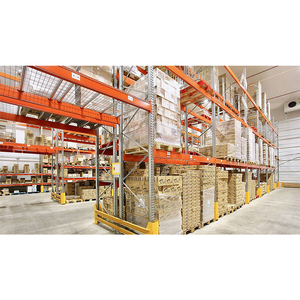
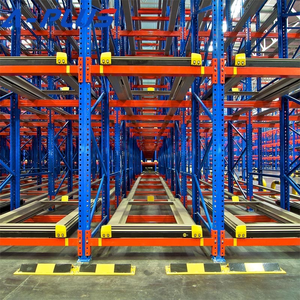
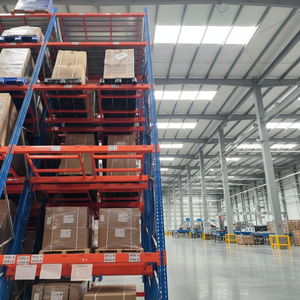
Mobile pallet racking (motorized mobile racking) represents a profound paradigm shift in industrial storage mechanics. Unlike static rack installations that require permanent access aisles every 3.0 to 4.2 meters, mobile racking systems mount heavy-duty superstructures onto continuous, electronically motorized chassis. These motorized bogies glide along sub-floor embedded guide rails, compressing multiple storage blocks into a singular dense footprint. When access to a specific pallet location is called by an operator or warehouse management system (WMS), the entire bank of multi-tier racks smoothly shifts laterally, opening an aisle precisely where required.
This operational architecture delivers an unprecedented 80% to 90% space recovery over conventional selective layouts and boosts net pallet holding volume by up to 180% within the exact same building envelope. The mechanical viability of such immense moving mass—often exceeding hundreds of metric tons per motorized chassis block—hinges on the structural metallurgy of the base chassis and precision laser-surveyed rail engineering.
Chinese manufacturing centers have achieved world-class mastery in roll-forming high-yield structural steel. Utilizing micro-alloyed cold-rolled profiles such as Q235B and Q355B, tier-one manufacturers fabricate continuous upright frames with yield strengths exceeding 355 MPa. The integration of closed-loop inverter motor controls ensures soft-start and soft-stop acceleration curves. This damping geometry prevents pallet shift, harmonic column oscillations, and load spillage during motor engagement, maintaining complete compliance with the rigorous dynamic stability thresholds mandated under European Norms (EN 15512:2020) and the Federation of Materials Handling (FEM 10.2.07).
Procurement directors and chief supply chain officers must balance upfront capital investment (CapEx), operational throughput velocity (OpEx), SKU selectivity, and land development constraints. The engineering matrix below contrasts mobile racking systems against competing static and semi-automated intralogistics configurations:
| System Architecture | Floor Space Efficiency | SKU Selectivity (Direct Access) | Cold Store Energy Savings | Floor Rail Embedding Required | Initial CapEx Profile |
|---|---|---|---|---|---|
| Motorized Mobile Racking | Ultra-High (85-90%) | 100% Direct Access | High (-45% to -55%) | Yes (Surface/Recessed) | Moderate to Balanced |
| Standard Selective Racking | Low (35-45%) | 100% Direct Access | None (Baseline Cost) | No (Direct Anchoring) | Low |
| Double Deep Pallet Racking | Moderate (55-65%) | Reduced (~50% Direct) | Moderate (-15%) | No | Low to Moderate |
| Drive-In / Drive-Through | High (70-75%) | Poor (Strict LIFO/FIFO) | Good (-25%) | Guide Rails Optional | Moderate |
| Automated Crane AS/RS | Maximum (90-95%) | 100% Automated | High (-50%) | Civil Monorail Rigidity | Extremely High |
As international supply chains navigate near-shoring and globalized procurement, selecting an authoritative Chinese manufacturing partner provides profound structural, engineering, and fiscal benefits. China's industrial clusters along the Yangtze River Delta and Greater Bay Area boast deep vertical integration: from direct raw coil procurement at state-owned steel mills (Baosteel, Shougang) to high-speed 40-station automated CNC roll-forming lines, automated laser tube cutting, and fully conveyorized German-engineered electrostatic powder coating tunnels.
Every industrial project undergoes finite element analysis (FEA) to simulate dynamic wheel loads, column buckling, seismic ground acceleration (IBC / Eurocode 8), and floor slab punch-shear stress before a single beam is fabricated.
Full manufacturing execution system (MES) traceability provides raw material heat certificates, mill test sheets, dry film thickness (DFT) verification, and European EN 15512/15620 compliance dossiers on every container load.
From custom 50mm, 75mm, or 76.2mm beam connector hook geometries to tailor-made cold room drive bogies, China's elite manufacturers deliver turnkey OEM components compatible with leading European and North American chassis.
The international procurement landscape for material handling equipment is undergoing structural transformation driven by macro-logistics shifts, rising industrial land valuations, and aggressive industrial decarbonization goals. Forward-thinking procurement officers must navigate the following evolving dynamics:
Global buyers are moving away from raw FOB port transactions. Modern procurement mandates comprehensive Delivered Duty Paid (DDP) agreements including factory-certified Chinese technical supervisors dispatched to manage rail leveling, laser alignment, and localized PLC integration alongside domestic installation crews.
With food security and pharmaceutical distribution expanding rapidly across the Middle East, Southeast Asia, and the Americas, building sub-zero cubic volume is financially exorbitant. Mobile racking is becoming the default standard in cold storage, driving demands for low-temperature ductile steels, synthetic non-freezing lubricants, and energy-efficient brushless geared servomotors.
Rather than simply purchasing the lowest price-per-ton steel, sophisticated engineering teams calculate 15-year TCO metrics. These factor in building footprint reduction, property tax savings, civil concrete volume minimization, HVAC energy draw, and modular re-configurability when facility lease terms evolve.
Contractual procurement frameworks increasingly specify that physical mobile racking hardware must ship accompanied by standardized BIM/Revit architectural digital twins, complete with sensor mounting interfaces for vibration, chassis deflection, and motor diagnostic telemetry.
The convergence of material science, industrial automation, and edge-computing safety architecture is propelling mobile pallet racking far beyond simple mechanical steel carriages. Tier-one Chinese manufacturers and international R&D consortiums are actively deploying cutting-edge technical enhancements:
1. Optical Light Curtains & Safety Field Scanners: Early-generation systems relied primarily on physical bumper trip bars. Contemporary mobile racking utilizes SIL 3-rated safety photoelectric light grids along the length of each chassis, coupled with Time-of-Flight (ToF) laser scanners. If an operator, order-picker, or stray pallet fragment enters an active closing aisle, the decentralized safety relay trips within 40 milliseconds, initiating electromagnetic braking to avoid collision.
2. WCS/WMS Dynamic Synchronous Opening: Mobile racks are no longer isolated manual push-button islands. High-level Warehouse Control Systems (WCS) communicate directly with the mobile chassis via industrial Wi-Fi or slotted optical busbars. When incoming orders require multiple picks across distinct bays, the mobile bank automatically executes a "night parking" sequence (equidistant spacing across all aisles to allow uniform air flow in cold stores) or pre-opens target picking aisles in anticipation of automated guided vehicle (AGV) routing.
3. Low-Profile Sub-Floor Flush Guide Rail Engineering: Civil construction tolerances have progressed markedly. Modern installations deploy induction-hardened, laser-aligned flat guide rails embedded seamlessly into the concrete slab topping. This creates a zero-threshold transit surface, eliminating tire degradation on reach trucks and counterbalance forklifts while preserving structural floor integrity under extreme dynamic wheel loads.
Authoritative engineering answers addressing civil construction, seismic safety, quality assurance, and project execution realities.
Mobile pallet racking imposes intense point loads along the rail tracks, differing from static baseplates. Concrete slabs typically require minimum compressive strengths of C30/37 or 35 MPa, with a minimum slab thickness ranging from 200mm to 250mm depending on stack height and single-bay gross weight. Floor flatness must adhere strictly to DIN 18202 Table 3 Group 4 (or ASTM E1155 F-min numbers). Rails are aligned using precision optical leveling lasers to within ±1.0mm per 10 meters of rail length, followed by high-strength non-shrink epoxy or micro-expansion cement grouting.
For installations in seismically active regions (e.g., California, Chile, Japan, New Zealand), engineering models incorporate dynamic modal response spectrum analysis governed by Eurocode 8, FEM 10.2.08, or IBC/RMI codes. High-ductility structural Q355B steel is utilized for upright columns, paired with heavy-gauge cross-bracing diagonals, welded heavy-duty baseplate shoes, mechanical spine ties, and chassis anti-tip guide claws that interlock underneath the embedded rail head to physically prevent overturning moments during seismic shear accelerations.
Refrigerating industrial air volume is one of the single highest operating expenditures in cold-chain logistics. By eliminating up to 85% of redundant empty access aisles, mobile racking shrinks the total required refrigerated room volume by 40% to 50% for identical pallet quantities. Furthermore, during low-activity or off-peak hours, the control system engages an automated "night mode" or ventilation sequence, separating all mobile bases slightly to maintain uniform thermal circulation, preventing frost-pockets and minimizing compressor duty cycles down to -30°C.
Technically, existing upright frames and load beams can be retrofitted onto new motorized mobile bases, provided the column profiles meet verified load capacities and upright base drilling patterns match chassis bolster mounts. However, in practice, a comprehensive structural integrity audit is mandatory: dynamic mobile movements transfer torsional and lateral loads that static racks were rarely engineered to endure. In many projects, installing a purpose-engineered mobile rack superstructure yields a far higher safety coefficient and longer design life at a marginal cost differential.
Standard engineering lead times range from 4 to 6 weeks from final approval of CAD layout drawings and civil rail plans to container loading at major Chinese ports (Shanghai, Ningbo, Qingdao, Shenzhen). High-volume projects (over 5,000 pallet positions) are typically phased in shipping lots. Beams, upright frames, and chassis rails are precision bundled with protective corrugated paper and heavy poly strapping, designed to maximize 40ft High Cube (40HC) ocean container weight and cube envelopes without component rubbing or surface powder-coat abrasion.
Compliance with NFPA 13 and EN 12845 fire safety codes is achieved through flexible pantograph piping assemblies or telescopic high-pressure articulated joints that supply water to in-rack sprinkler heads across moving chassis. Additionally, the master control panel interfaces directly with the central building fire alarm system (FAS). Upon smoke or heat detector trip, the mobile racks immediately lock all manual operator inputs and initiate an automatic full-open sequence, spacing out all blocks to provide fire brigade hose access and thermal ventilation.