No matching pages. Try "pallet", "mezzanine" or "cantilever".
No matching pages. Try "pallet", "mezzanine" or "cantilever".
Engineered for standard step beams, box beams, structural channels, and heavy mold dies. Manufactured from cold-formed high-tensile steel with certified dynamic and static deflection ratings.
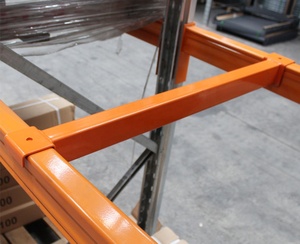
In contemporary intra-logistics facilities and automated distribution centers, pallet support bars (often designated as pallet cross beams, rack cross ties, or skid support channels) are not merely passive accessories; they are vital load-bearing safety components designed to maintain systemic structural equilibrium. While longitudinal rack load beams carry the primary static and dynamic pallet weight across the upright frame pitch, pallet support bars directly address three catastrophic failure vectors: weak or non-standard wooden skid deflection, horizontal beam splay (lateral torsional buckling under heavy localized point loads), and misplaced pallet drops caused by operator misalignment or seismic lateral force oscillations.
Leading China pallet support bar factories and exporters engineer cross members in strict compliance with globally harmonized material standards—most notably the Rack Manufacturers Institute (RMI) specification ANSI MH16.1, European Norms EN 15512 (Cold-formed structural racking design) and EN 15620 (Installation tolerances), and the Australian Standard AS 4084. When pallets with compromised bottom boards, non-standard footprint dimensions (e.g., 800×1200mm Euro pallets versus 1000×1200mm industrial pallets or 48×40 inch GMA pallets), or heavy plastic containers sit across beams without intermediate support, severe localized deflection can trigger immediate frame collapse. Precision-formed Chinese pallet support cross bars distribute these forces evenly across the front and rear step or box beams, preserving the load-carrying capacity and longevity of the entire warehouse infrastructure.
Pallet support cross bars are engineered in distinct geometric cross-sections depending on the beam profile (step beam vs. structural box beam vs. structural C-channel) and operational handling demands. Sourcing teams must identify the precise mechanical profile suited to their rack infrastructure:
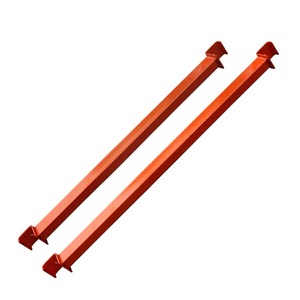
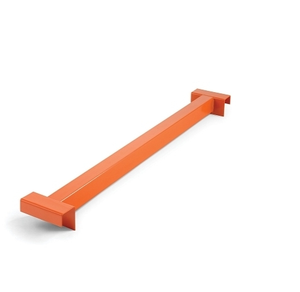
Engineered exclusively for stepped racking beams. Features precision pre-notched, formed steel end wings that sit flush inside the beam step rebate (typically 20mm to 25mm depth). Eliminates beam obstruction, enabling smooth loading and preventing forklift fork snags during pallet placement.
Constructed with an inverted hat section (Ω profile). The lateral outer flanges rest directly on the top surface of box beams or step beams, secured via self-drilling Tek screws through pre-punched fastener holes. Provides high moment of inertia (Ix) against severe mid-span bending moments.
Designed with downward wrap-around clamping brackets on both ends that firmly grip structural box or tube beams. The saddle design locks the distance between front and rear beams, acting as a structural tie-rod that prevents beam separation under dynamic forklift vibration.
The following comparative engineering data illustrates the structural capabilities, standard cross-sections, and application envelopes of top Chinese manufactured pallet support components:
| Profile Designation | Standard Steel Grade | Section Thickness | Rated Capacity (Pair) | Beam Type Interface | Primary Application Environment |
|---|---|---|---|---|---|
| Flanged Step Bar (50×30mm) | Q235B Cold-Rolled | 1.5 mm – 1.8 mm | 1,000 kg – 1,200 kg | Standard Step Beam | General retail, e-commerce, light FMCG warehousing |
| Reinforced Hat-Section (Top-Hat) | Q235B / Q355B Steel | 1.8 mm – 2.0 mm | 1,300 kg – 1,600 kg | Box Beam / Flat Channel | Logistics 3PL, heavy pallet storage, automotive parts |
| Structural C-Channel Cross Tie | Q355B High-Yield | 2.0 mm – 2.5 mm | 1,800 kg – 2,200 kg | Structural C-Beam / Roll Box | Heavy raw materials, chemical drums, machinery dies |
| Heavy Tubular Saddle Bar (Box Tube) | Q355B / ASTM A500 | 2.5 mm – 3.2 mm | 2,200 kg – 2,800 kg | Roll-Formed Box Beam | Cold storage, dynamic drive-in, seismic-zone high bays |
| Fork-Entry Pallet Support Bar | Q235B / Galvanized | 2.0 mm – 3.0 mm | 1,500 kg | Multi-Level Pallet Racking | Un-palletized container skids, metal cage boxes, slip sheets |
Material integrity is the bedrock of warehouse safety. Tier-1 China manufacturers and exporters source cold-rolled steel coils exclusively from premier state-accredited steel mills such as Baosteel, Shougang, and Ansteel. For standard warehouse ambient storage, Q235B structural carbon steel (yield strength $f_y \ge 235 \text{ N/mm}^2$, tensile strength $R_m = 370\text{–}500 \text{ N/mm}^2$) provides ductile deflection resilience. For extreme high-density racks, structural cold chain storage, or automated storage and retrieval systems (AS/RS), Q355B low-alloy high-strength steel ($f_y \ge 355 \text{ N/mm}^2$) is deployed to achieve higher load thresholds with minimized component deadweight.
Surface finishing directly governs the corrosion resistance life cycle. Elite Chinese exporters maintain automated continuous surface pre-treatment lines (de-greasing, pickling, iron phosphate conversion) followed by automated electrostatic powder coating using environmentally benign thermoset polyester powders (AkzoNobel or PPG). The standard dry film thickness (DFT) is held within 60 to 90 microns, verified via electromagnetic coating thickness gauges. For high-humidity pharmaceutical cold storage (-30°C) or open-air canopy facilities, continuous pre-galvanized coils (zinc coating Z120 to Z275 g/m²) or batch hot-dip galvanization conforming to ISO 1461 / ASTM A123 (yielding 80+ microns of zinc-iron metallurgical alloy protection) ensure rust-free durability exceeding 25 years.
Market forces, automation integration, and global decarbonization commitments are rapidly transforming pallet support bar procurement protocols for international enterprise buyers.
With the rapid adoption of automated automated crane AS/RS and autonomous mobile robots (AMRs), beam deflection and bar variance must not exceed ±0.8mm. Future contracts demand precision CNC laser profiling and automated robotic forming to prevent sensor misreads.
EU CBAM (Carbon Border Adjustment Mechanism) and ESG frameworks mandate comprehensive embodied carbon documentation. Chinese mills are shifting to scrap-based Electric Arc Furnaces (EAF) and issuing certified Environmental Product Declarations (EPDs) for cold-formed steel racking components.
Rising labor and contractor installation rates globally have accelerated the demand for tool-free, snap-lock pallet support bars. Patented spring-loaded retaining clips and integrated self-locking tabs eliminate field screw drilling while fully satisfying seismic retention standards.
With maritime freight volatility, buyers increasingly prioritize nestable, stackable cross bar geometries. Precision-tapered flanged cross channels allow 35% higher cubic packing densities inside standard 40ft High Cube containers, significantly cutting per-unit shipping overhead.
China’s leading industrial equipment export clusters—predominantly concentrated in Jiangsu (Nanjing, Suzhou), Shandong, and Guangdong provinces—have undergone massive smart manufacturing upgrades. Traditional manual shear-and-brake workshops have been superseded by 18-to-24 station continuous roll-forming lines coupled with inline hydraulic punching and high-speed flying shears. This enables continuous production speeds exceeding 30 meters per minute while maintaining dimensional tolerances well within ISO 2768-m standards.
Furthermore, leading factories now integrate advanced Finite Element Analysis (FEA) software into their OEM engineering workflow. Before stamping a single coil, 3D structural simulations assess stress distribution, localized buckling tendencies, and yield behavior under asymmetrical load conditions. Automated coordinate measuring machines (CMM) and digital universal tensile testing machines generate real-time Mill Test Reports (MTR) traceable to individual steel heats, giving international logistics developers total confidence in product reliability.
Combining rigorous structural engineering, immense production scale, and seamless turnkey international project coordination.
Full design and calculation compliance with ANSI MH16.1 (US), EN 15512 / EN 15620 (Europe), and AS 4084 (Australia). Load rating charts backed by independent lab destructive load tests.
Complete flexibility in custom flange angles, step depths (from 18mm to 35mm), overall bar lengths (from 600mm to 1800mm), and profile gauges to fit any international beam profile seamlessly.
Scalable production throughput exceeding 20,000 units weekly across automated continuous stamping and roll-forming cells, securing aggressive multi-warehouse rollout schedules.
Eliminate intermediary markups. Components are bundled with steel strapping, corner edge protectors, and treated wooden dunnage designed for rapid forklift unloading at project destination docks.
Authoritative answers to the most common engineering and procurement inquiries regarding China pallet support bars.
Flanged support bars are designed specifically for step beams with a horizontal ledge (standard 20mm or 22mm rebate). The wings rest inside the step, leaving the top pallet level flush with the top of the beam. Top-hat support bars sit across the top surface of box beams or structural channels and are fastened via screws. If your racking utilizes smooth box beams without a step rebate, you must select top-hat or over-the-beam saddle styles.
Under ANSI MH16.1 (RMI standard), the typical design safety factor is 1.65 based on cold-formed steel yield strength. Under European standard EN 15512, limit state design applies a partial material factor ($\gamma_M$) of 1.10 coupled with variable action load factors of 1.4 to 1.5. In practice, a cross bar rated for 1,200 kg per pair will have a theoretical ultimate structural yield point exceeding 1,980 kg under uniformly distributed static loading.
Standard engineering practice prescribes a minimum of two support bars per pallet position. In a standard 2.7-meter beam bay supporting two standard industrial pallets (1000×1200mm), four support bars are required. For three-pallet bays (e.g., 3.6-meter beams) or in seismic zones and applications with concentrated line loads, three support bars per pallet position (six to nine per bay) may be required by safety inspectors.
Yes. When properly secured via retaining screws or integrated locking clips, pallet support bars serve as cross-tie stabilizers. Under heavy vertical pallet loads, longitudinal beams experience negative bending that induces lateral torsional buckling. The cross ties mechanically bind the front and rear beams, maintaining their axial alignment and significantly improving overall frame stability.
For sub-zero cold storage (-20°C to -35°C), high-humidity environments, or agricultural packing houses, continuous pre-galvanized steel (zinc coating Z180 to Z275 g/m²) or batch hot-dip galvanization (ISO 1461) is strongly recommended. Low-grade paint coatings can crack, peel, and oxidize under thermal shock. Pre-galvanized cross bars offer robust sacrificial cathodic protection with zero risk of micro-cracking.
Elite manufacturers adhere to ISO 2768-m (medium tolerance) standards. Total length tolerance is strictly held within ±1.0 mm, end flange notch depth within ±0.5 mm, and cross-section profile angles within ±1 degree. These strict limits guarantee effortless manual drop-in assembly on job sites without the need for manual hammering or re-working.
Support bars are packaged in nested, interlocking bundles of 50 to 100 units strapped with high-tensile polyester or steel bands. Each bundle includes solid heavy-gauge paper corner protectors and heavy-duty plastic stretch film wrapping. The bundles are mounted on treated, ISPM-15 compliant wooden skids or structural steel lifting runners, allowing rapid unloading via counterbalance forklifts at the destination.
Standard export quality packages include original Mill Test Certificates (MTR / EN 10204 3.1) showing raw coil chemical analysis and mechanical yield values, third-party destructive load test verification reports, dry film thickness (DFT) paint test certificates, and full Certificate of Origin (CO / Form E / Form F) documentation for tariff management.
Send us your pallet dimensions, beam profiles (step/box/tube), and loading specifications. Receive a comprehensive engineering load report, 3D CAD compatibility models, and container-optimized factory-direct quotation within 24 hours.