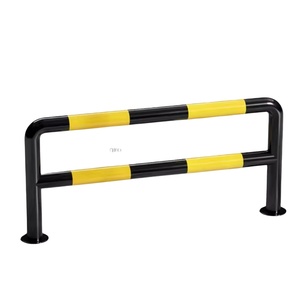
Heavy Duty Pallet Rack Column Guard Upright Protector End Frame Protector Barrier
- Material: 5mm Structural Steel
- Standard: EN 15635 Protection
- Coating: Signal Yellow / Black
No matching pages. Try "pallet", "mezzanine" or "cantilever".
Engineered with Q235B/Q355B high-tensile cold-rolled steel, calibrated for standard Euro pallets (EUR 1, 1200×800 mm) and ISO industrial containers.
Austria's geostrategic position as the core logistics crossroad connecting Western European production powerhouses with Central and Eastern European (CEE) growth corridors places stringent demands on high-throughput intralogistics infrastructure. Across Upper Austria (Linz-Wels-Steyr), Greater Vienna (Großraum Wien), Lower Austria, and the Styrian economic belt around Graz, distribution hubs operate under severe spatial constraints, strict environmental building directives, and rigorous structural safety frameworks mandated by ÖNORM EN 15512, ÖNORM EN 15620, and Austrian occupational health regulations (Arbeitsstättenverordnung - AStV § 26).
As a specialized direct-to-enterprise industrial racking manufacturer, our engineering teams bridge the gap between heavy industrial metallurgy and precise Austrian site requirements. We deliver turnkey static storage configurations optimized for standard Euro pallets (1200 × 800 mm, UIC 435-2), industrial mesh cages (Gitterbox DIN 15155), and non-standard automated unit loads, providing complete structural calculations, seismically verified frame profiles, and durable anti-corrosion surface treatments.
Procuring industrial racking systems for Austrian facilities requires comprehensive static documentation and certification. Unlike lighter commercial shelving, industrial pallet racks are load-bearing steel structures subject to the European Standard series adopted by the Austrian Standards Institute (Austrian Standards International):
ÖNORM EN 15512 (Structural Design of Adjustable Pallet Racking): Specifies finite element modeling (FEM) procedures, semi-rigid connection analyses between upright columns and horizontal box beams, and global second-order frame stability verification under full symmetrical and asymmetrical bay load conditions.
ÖNORM EN 15620 (Tolerances, Deformations, and Clearances): Governs the operational interface between material handling equipment (such as narrow-aisle VNA turret trucks, automated stacker cranes, and reach trucks) and the steel structure. Our automated roll-forming ensures upright straightness deviations remain well within the 1/1000 threshold required for high-bay narrow aisle operations exceeding 12 meters clear height.
Seismic Design According to Eurocode 8 (ÖNORM EN 1998-1): While Alpine Austria is globally famed for its scenic geography, regional seismic risks exist, particularly along the Vienna Basin, the Mur-Mürz fault zone in Styria, and parts of the Inn Valley in Tyrol. Our engineering desk incorporates regional ground acceleration parameters ($a_g$) and soil class factors directly into the baseline upright section modulus, baseplate sizing, and expansion anchor calculations to ensure seismic compliance without excessive material waste.
The structural reliability of an industrial storage rack depends heavily on coil chemistry and the continuous cold-roll-forming manufacturing process. We reject secondary-grade commercial hot-rolled steels in favor of primary certified mill-grade Q235B and Q355B structural carbon steel, offering mechanical parity to European designations S235JR and S355JR under EN 10025-2.
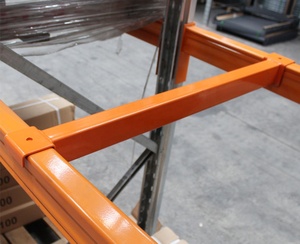
For beams carrying heavy palletized machinery spares or chemical vats up to 4,500 kg per beam level, we deploy dual-C interlocked cold-formed welded box beams. The welded interlock profile creates a continuous structural closed section with exceptional torsional stiffness and minimal vertical deflection ($\le L/200$ under full permissible live load). Uprights are cold-punched with CNC-calibrated hydraulic punching tools, preventing micro-fractures in the steel matrix around teardrop or omega interlocking slots.
Finishing is conducted in a multi-stage automated pre-treatment and electrostatic powder coating line. Following ultrasonic degreasing and iron-phosphate conversion, parts are coated with high-grade architectural epoxy-polyester powder polymer cured at 200°C. This ensures high impact resistance against pallet strikes, surface scratch resilience, and compliance with indoor volatile organic compound (VOC) limits. For cold-chain logistics facilities operating down to -30°C in food-grade warehouses, we provide pre-galvanized (Z275 coating mass) or hot-dip galvanized components (ISO 1461) to eliminate hydrogen embrittlement and low-temperature brittle fractures.

Engineered storage architectures tailored to the operational demands of regional manufacturing clusters.
In the heavy industrial belt of Linz, Wels, and Steyr, racking must support dense steel components, heavy engine castings, and stamping dies. Our heavy-duty selective and double-deep racking integrates reinforced pallet cross bars and heavy C-profile column guards to withstand forklift impact in high-tempo tiered component supply chains.
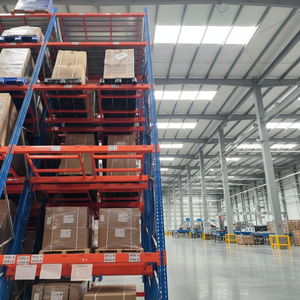
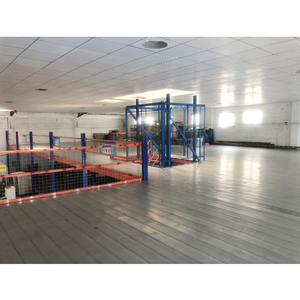
Distribution centers along the S1 outer ring road, Wiener Neudorf, and the Vienna Airport logistics corridor require maximum volumetric cubic utilization. Multi-tier rack-supported mezzanine platforms and push-back systems optimize picking density for pharmaceutical distributions, cosmetic fulfillment, and retail cross-docking operations.
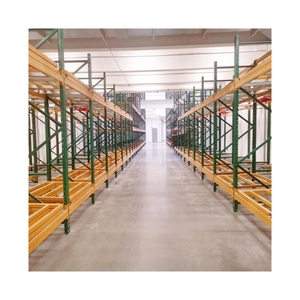
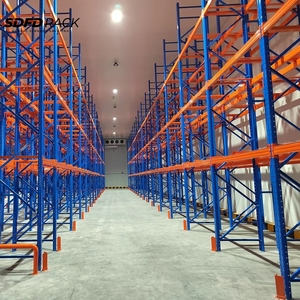
Food processing clusters in Graz and southern Austria demand drive-in and push-back racking capable of performing flawlessly in refrigerated cold rooms (-25°C). For the Carinthian and Alpine timber industries, heavy-duty cantilever racking provides open, unobstructed arm spans for raw lumber, extrusion profiles, and sheet goods.
The industrial property landscape in Austria is characterized by low vacancy rates in prime logistics nodes, restrictive municipal zoning regulations (Raumordnung), and high construction costs. These pressures are transforming how corporate buyers, 3PL providers, and factory managers invest in warehouse storage:
1. Vertical Cubic Space Maximization Over Land Expansion: Because acquiring new industrial building plots (Gewerbegrundstücke) in Upper Austria or Greater Vienna incurs high capital expenditure and lengthy environmental approval procedures, enterprise clients prioritize vertical cubic utilization. Racking systems are engineered to reach 10 to 15 meters clear height, converting previously idle vertical space into active inventory bays using narrow-aisle (VNA) or high-density rack-supported mezzanine layouts.
2. Automation Readiness & AGV Integration: Austrian logistics operators are modernizing operations by integrating automated guided vehicles (AGVs) and autonomous mobile robots (AMRs). Racking structures must provide precision tolerances: frame plumbness, beam deflection stability, floor anchor rigidity, and laser-aligned guide rail configurations must match the sensory parameters of automated reach equipment.
3. Carbon Footprint and ESG Compliance: Environmental sustainability is central to Austrian corporate procurement. Our manufacturing plant adheres to modern environmental standards, using closed-loop powder recovery systems, RoHS-compliant polymer powders, and high-efficiency electric roll-forming lines. The resulting structural steel profiles provide maximum load capacity with optimized weight, reducing shipping fuel consumption across European trade routes.
Evaluate accessibility, pallet density, capital expenditure, and equipment requirements.
| Racking Architecture | Pallet Selectivity | Volume Utilization | Stock Rotation | Typical MHE Requirement | Austrian Industry Fit |
|---|---|---|---|---|---|
| Selective Pallet Racking | 100% Direct Access | Standard (40-50%) | FIFO / LIFO Any | Standard Counterbalance / Reach Truck | General 3PL & FMCG |
| Double-Deep Pallet Rack | 50% Direct Access | High (60-65%) | LIFO Priority | Deep-Reach Pantograph Truck | Buffer Warehousing |
| Push-Back Rack (Gravity/Cart) | Lane-Based Selectivity | Very High (70-75%) | LIFO Dynamic | Standard Counterbalance Forklift | Cold Storage & Food Hubs |
| Drive-In / Drive-Through | Bulk Lane Access | Maximum (80%+) | Strict LIFO / FIFO | Narrow-Chassis Forklift | Beverage & High-Batch Goods |
| Heavy Duty Cantilever | 100% Side & Face Access | High for Long Goods | Flexible | Side-Loader / Multi-Directional Truck | Timber, Pipes & Steel Profiles |
| Rack-Supported Mezzanine | Multi-Level Manual Access | Doubles/Triples M² | High Pick Velocity | Order Pickers / Hand Pallet Trucks | E-Commerce, Spare Parts & Garments |
By eliminating multiple intermediary trading markups, we provide Austrian plant managers, logistics directors, and general contractors direct access to our heavy engineering production facility. Every upright section, connector bracket, and bracing lattice is manufactured under strict ISO 9001 quality management systems.
Direct technical answers addressing statics, compliance, delivery logistics, and annual inspections.
Yes. All our industrial racking systems comply with European structural design standards, specifically ÖNORM EN 15512 for structural design principles, ÖNORM EN 15620 for beam deformation and clearance tolerances, and EN 15635 for operational safety. For every project destined for Austria, our engineering department provides static calculation dossiers verifying load limit states, serviceability states, and frame connection stiffness to satisfy local building authorities (Baubehörde) and AUVA labor inspectorates.
Yes. Although parts of Austria feature minimal seismic hazard, key industrial zones—such as the Vienna Basin (Wiener Becken), the Mur-Mürz valley in Styria, and regions across Tyrol and Carinthia—require seismic load verification according to Eurocode 8 (ÖNORM EN 1998-1). We calculate base shear loads, anchor ductility requirements, and column section moduli matching your specific Austrian postal code and ground soil conditions to guarantee complete structural stability.
We supply turnkey logistics terms, including CIF (Rotterdam, Hamburg, or Koper) and full DDP (Delivered Duty Paid) directly to your project jobsite in Austria (Linz, Vienna, Graz, Innsbruck, etc.). We manage export documentation, multimodal rail/truck transit through Central European logistics corridors, and customs entry protocols. All shipments are bundled in export-grade steel banding, moisture-barrier polymer wrap, and heavy timber blocking to protect factory powder coatings from transit damage.
Our standard beam spans and upright frame depths are engineered around the standard European pallet pool. Standard 1,100 mm frame depths are optimized for longitudinal placement of EUR 1 (1200 × 800 mm) pallets, ensuring the required 50 mm front and rear overhang. Standard beam lengths of 1,800 mm (2-pallet bay), 2,700 mm (3-pallet bay), and 3,600 mm (4-pallet bay) provide clearance margins compliant with EN 15620. We also supply cross-support bars for industrial steel mesh boxes (DIN 15155 Gitterboxen).
Under the Austrian Arbeitsstättenverordnung (AStV § 26) and ÖNORM EN 15635, all power-operated or forklift-loaded storage equipment must undergo certified technical inspections at least once every 12 months. We provide comprehensive technical handover packs including as-built CAD drawings, component part numbers, permissible load capacity signage (Belastungsschilder), beam safety locking verification, and inspection logbooks to ensure seamless compliance during TÜV or certified rack safety audits.
Yes. For sub-zero operations down to -30°C in grocery, dairy, and pharmaceutical cold hubs, we use certified structural steel with verified low-temperature Charpy V-notch impact toughness (guaranteeing material ductility and preventing cold embrittlement). We recommend continuous pre-galvanized upright frames or specialized low-temperature powder coatings combined with high-density push-back or drive-in configurations to maximize refrigeration efficiency.
To prepare an optimized CAD layout and quotation, we require: (1) Building architectural CAD drawing or dimensions with clear ceiling heights under sprinkler/truss obstructions; (2) Pallet specifications (width, depth, height, and maximum loaded weight); (3) Forklift model, maximum mast lift height, and minimum aisle width (AST); (4) Floor slab specifications (thickness, concrete strength class, e.g., C20/25); and (5) Operational environmental conditions (ambient, chilled, or deep freeze).
Direct OEM manufacturing, certified ÖNORM static calculations, and rapid European container delivery. Connect directly with our lead structural application engineers to review your building layout, calculate bay loadings, and optimize your cubic storage density.