High Throughput
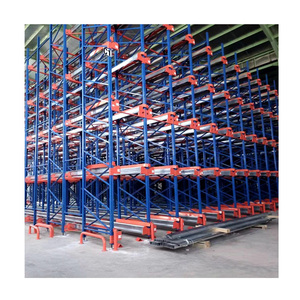
Adjustable High-Speed Auto Shuttle Pallet Racking System
- Automation: Radio Shuttle 4.0
- Bay Load: Up to 1,500 kg/pallet
- Access Type: FIFO & LIFO Adaptable

No matching pages. Try "pallet", "mezzanine" or "cantilever".
Factory-direct warehouse storage components engineered from high-yield Q235B and Q355B structural steel, tested for micro-deflection limits, static point loading, and extreme operational throughput.
We combine advanced metallurgy, automated roll-forming precision, and documented structural verification to de-risk high-bay warehouse projects across Europe, the Middle East, the Americas, and APAC.
Over 24 automated roll-forming lines process structural uprights up to 12 meters in a single continuous stroke without splices, minimizing internal stress concentrations and maintaining millimeter tolerances.
Every structural layout is modeled through ANSYS FEA software. We simulate dynamic earthquake spectra, live pallet impacts, and eccentric loading conditions to guarantee full compliance with EN 15512 and RMI standards.
Equipped with 6-axis ABB robotic MIG welding cells, our beam connector brackets achieve deep, uniform weld penetration with zero cold lap, ensuring fail-safe structural shear ratings under extreme dynamic cycles.
A 7-stage automated chemical cleaning and pre-treatment line paired with Swiss GEMA electrostatic powder application yields a 70–90 µm cured coating with superior adhesion (ISO 2409 Grade 0) and 500-hour salt spray resistance.
When sourcing industrial steel shelving from China factories, structural reliability depends directly on certified raw material specifications. Inferior manufacturers often cut costs by utilizing commercial hot-rolled sheet scrap with non-uniform tensile boundaries or unverified carbon equivalents.
Our manufacturing hub exclusively sources prime hot-rolled and cold-rolled continuous coils from top-tier state mills (such as Baosteel and Shougang). Upright profiles are roll-formed from Q235B and Q355B structural carbon manganese steel, delivering guaranteed minimum yield strengths ($f_y$) of 235 MPa and 355 MPa, respectively.
Factory Testing Insight: Mill Test Certificates (MTC) matching EN 10204 Type 3.1 accompany every shipping batch, certifying chemical ladle analysis (C, Si, Mn, P, S) and mechanical elongation percentages before cold profiling begins.
Understanding structural divergence between genuine heavy-duty industrial warehouse shelving and consumer-grade light shelving is vital for life-cycle safety and asset depreciation:
| Engineering Parameter | Heavy Industrial Spec | Light Retail / Utility Spec |
|---|---|---|
| Steel Metallurgy | Q235B / Q355B Cold-rolled | Q195 / Commercial recycled strip |
| Upright Thickness | 1.5 mm – 2.5 mm continuous roll | 0.6 mm – 1.0 mm stamped sheet |
| Max Bay Load Capacity | Up to 24,000 kg (per upright frame) | 300 kg – 1,000 kg max bay |
| Beam Connection | Interlocking claws + Safety lock pins | Friction slots or light bolt tabs |
| Anchor Baseplate | Laser-cut heavy footplate, M10–M12 | Plastic end caps or 1.0 mm clip |
| Design Code Compliance | EN 15512, RMI MH16.1, AS4084 | None / In-house arbitrary rating |
Global supply chain leaders no longer purchase static steel racks purely on steel weight. Strategic warehouse procurement now factors in automated material handling interface, high-density space dynamics, and carbon footprint accountability.
Standard static pallet bays are giving way to high-density 4-Way Radio Shuttle and AS/RS (Automated Storage & Retrieval Systems) rail profiles. Cold-roll manufacturing tolerances must now adhere to ISO 2768-m or tighter, preventing autonomous vehicles from experiencing track derailment, optical sensor blind spots, or erratic acceleration bumps across expansion joints.
By shifting to ultra-high-strength steel grades such as Q355B and specialized micro-alloyed strips, modern China factories decrease profile self-weight by 12% to 18% while sustaining identical load-bearing and moment capacities. This engineering evolution substantially slashes international shipping container freight costs and total embodied carbon per storage bay.
Strict international ESG and European carbon border adjustment mechanisms (CBAM) mandate verified environmental transparency. Leading China factories have eliminated traditional solvent coatings in favor of closed-loop electrostatic powder lines with zero volatile organic compound (VOC) emissions, integrated RO wastewater filtration, and 98% powder overspray reclamation.
Ensure your capital expenditure achieves zero failure rates by applying our tier-1 industrial inspection checklist during your factory evaluation process.
Verify original steel coil Mill Test Certificates (MTC). Inspect spectrometer test logs verifying carbon content below 0.20% and manganese levels ensuring ductile cold deformation without micro-cracking at bend radii.
Measure CNC punched teardrop, diamond, or butterfly hole pitch uniformity over a continuous 10-meter span. Total accumulated pitch error must strictly reside within ±1.5 mm to guarantee frictionless beam assembly on site.
Perform dye-penetrant inspection (DPI) or ultrasonic non-destructive testing (NDT) on beam-to-claw connector welds. Zero porosity, undercuts, or cold laps per ISO 5817 Level B standards are acceptable on structural loads.
Industrial uprights and beams must be protected with corrugated corner guards, heavy composite strapping, high-density timber dunnage, and moisture-absorbing vapor inhibitors to endure 30+ days of ocean transit.
Direct engineering answers addressing steel thickness, structural codes, customized layouts, seismic calculations, and international freight logistics.
We exclusively use prime continuous cold-rolled and hot-rolled structural steel coils in certified Q235B (equivalent to ASTM A36 / European S235JR) and Q355B (equivalent to ASTM A572 Grade 50 / European S355JR). Every single production run is accompanied by EN 10204 Type 3.1 Mill Test Certificates verifying yield strength ($R_e$), tensile strength ($R_m$), elongation percentage ($A$), and exact chemical composition (C, Mn, Si, P, S).
Our structural design department calculates seismic actions according to the destination jurisdiction's mandated building codes, including Eurocode 8 (EN 1998), ASCE 7-22 / RMI MH16.1 in North America, and AS 4084 in Australasia. We utilize finite element dynamic modal response spectrum analysis, taking into account site soil classification, spectral acceleration parameters ($S_s, S_1$), and live load reduction factors to engineer custom heavy-gauge baseplates and additional diagonal vertical bracing towers.
Under maximum working uniformly distributed load (UDL), our beam deflection limit is strictly constrained to $L/200$ (maximum deflection $\le 1/200$th of the beam's clear entry length), or $L/250$ when demanded by high-clearance automated VNA or automated shuttle systems. This satisfies EN 15512 and FEM 10.2.02 deflection safety thresholds, preventing permanent elastic deformation and ensuring forklift drivers retain smooth horizontal entry clearances.
Yes. We maintain an in-house tooling and die department. We can produce standard European 50 mm pitch, 75 mm pitch, and North American 2-inch teardrop punch configurations. Custom roll-forming tooling can be developed for proprietary upright profiles. Surface powder finishes can be color-matched to any standard RAL or Pantone reference code using exterior-grade pure polyester powder resistant to UV chalking.
Ocean container shipping exposes steel components to salt fog, condensation (container rain), and severe multi-axis vibrational stresses. We apply a 4-tier packaging protocol: profiles are separated with non-marking corrugated cushioning, bundled with high-tensile polyester strapping, wrapped in 50-micron heat-shrink polyethylene protective film, and fitted with desiccant dry-packs inside each 40ft HQ container. Solid steel base cradles facilitate damage-free forklift slip-sheet unloading.
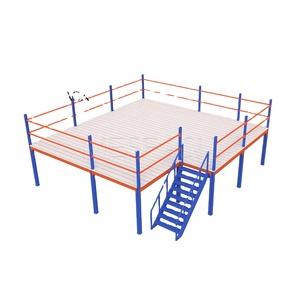
Yes. Our multi-tier rack-supported platforms and structural steel mezzanines can be specified with perforated open-grid steel decking or heavy-duty wire mesh floors with over 50% open area, allowing direct, unhindered sprinkler water penetration in accordance with NFPA 13 fire protection codes. We supply full structural calculations, staircase egress plans, safety kickplates, and loading signage to support fast municipality and Civil Defence site approvals.
Connect directly with our senior racking applications engineering team. Provide your warehouse clear height, building column grid, pallet metrics, and handling truck models to receive a comprehensive CAD proposal and DDP factory-direct quotation within 24 hours.