No matching pages. Try "pallet", "mezzanine" or "cantilever".
No matching pages. Try "pallet", "mezzanine" or "cantilever".
Direct from leading precision manufacturing facilities in China: load-tested upright column protectors, corner barriers, and high-capacity gravity racking components designed to eliminate forklift collision structural failures.
A rigorous engineering perspective on impact dissipation, Euler buckling limits, and floor slab shear mechanics in high-throughput automated and manual distribution hubs.
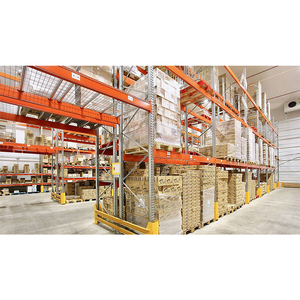
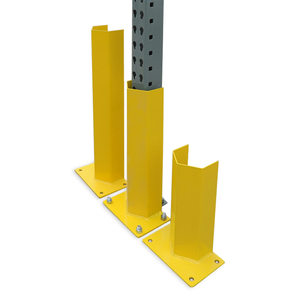
Pallet rack upright frames are cold-formed steel sections optimized strictly for axial compression loading. Under Euler's column formula, critical buckling load capacity drops precipitously when a forklift tines impact creates even a 3mm local dent or permanent bow. Our high-yield China-manufactured protectors absorb the direct shear force, preserving the upright cross-section geometry and maintaining overall warehouse bay capacity ratings without catastrophic structural failure.
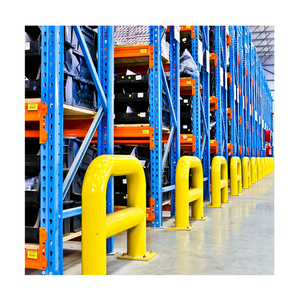
A standard 3.5-ton counterbalance forklift carrying a 1,000 kg load traveling at a moderate speed of 2.5 m/s possesses over 14 kiloJoules (kJ) of kinetic momentum. Standard upright frames buckle instantly under direct hit energies exceeding 400 Joules. Engineered pallet rack protectors function as sacrificial energy-dissipating barriers, distributing concentrated vehicle forces into floor-mounted heavy anchor bolts or elastomeric polymer dampening damp zones.
Traditional rigid steel post guards transmit 100% of collision shear straight into M12 or M16 concrete floor chemical anchors, often pulverizing the floor slab and causing costly slab re-coring. Modern China OEM innovations feature progressive deformation zones, curved deflection geometry, and polymer flex joints that dramatically mitigate ground-level anchor fatigue while preventing cracked floor slabs in seismic or heavy-load industrial facilities.
Comparative technical data evaluated against international FEM 10.2.02, EN 15512, and Australian AS 4084 warehousing integrity benchmarks.
| Protector Class | Primary Material & Grade | Energy Absorption | Anchor Shear Risk | Floor Footprint | Compliance Standards |
|---|---|---|---|---|---|
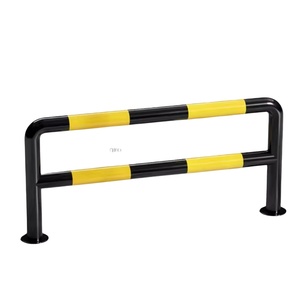
| U-Style Heavy Steel Guard | Q235B / Q355B Structural Steel (4.0-6.0mm) | 1200J - 2500J (Plastic deformation) | High (Requires heavy slab anchors) | Requires 30-50mm aisle clearance | EN 15512, OSHA 1910.176, AS 4084 |
| Direct Snap-On Polymer Armor | Engineered Modified HDPE / Polyurethane | 800J - 1600J (Elastic memory reset) | Zero (Non-anchored snap system) | Zero aisle loss; clips to frame | FEM 10.2.02, EN 15635 Inspection Free |
| End-of-Aisle Barrier Frame | Heavy Tubular Pipe & Double C-Channel Steel | 5000J - 12000J (Heavy vehicle impact) | Distributed over 4-8 anchor studs | Full rack row end coverage | EN 15620, SEMA Safety Code |
| Galvanized Freezer Armor | Hot-Dip Galvanized Structural Steel (ISO 1461) | 2000J - 3500J (Cold temperature stable) | Medium (Insulated slab anchors) | Aisle-side profile wrap | Cold Storage Logistics Standards |
Combining world-class Chinese manufacturing throughput with comprehensive international warehousing design, installation, and EN 15635 compliance expertise.
Every industrial protection setup is custom-engineered around specific pallet types, counterweight forklift turning radiuses, mast clearances, and building clear heights. We calculate bay loads, slab thicknesses, and floor joint tolerances prior to manufacturing, avoiding costly on-site installation retrofits.
Manufactured using certified premium raw coil steel with full mill test traceability (MTR). Continuous CNC stamping, robotic welding cells, and electrostatic thermohardening powder coatings deliver outstanding surface hardness, salt-spray corrosion resistance, and decades of structural longevity.
From primary architectural CAD design to professional overseas project execution, our technical engineering team provides full structural accountability. We supply certified load signs, dynamic deflection calculation certificates, and ongoing EN 15635 rack safety audit documentation for insurance compliance.
Optimized container loading plans, nested stack designs, and unified palletizing minimize sea freight volume, saving up to 35% in overseas transportation tariffs. Seamless supply pipelines across the Middle East, Europe, North America, Southeast Asia, and Australasia.
Market intelligence for global supply chain leaders: how automation, telematics, and ESG carbon mandates are reshaping warehouse protective hardware specifications.
Leading logistics operations are rapidly shifting toward sensor-integrated upright protectors equipped with embedded MEMS micro-accelerometers. These IoT devices log impact magnitude and timestamp collisions directly into the warehouse management system (WMS) or digital twin, instantly flagging whether an upright has exceeded the EN 15635 "Amber" or "Red" structural damage threshold before silent structural creep occurs.
With global frozen food and cold-chain pharmaceutical distribution expanding rapidly, standard plastics and basic carbon steel become brittle and prone to catastrophic cracking below -20°C. Modern procurement contracts now enforce -30°C Charpy V-notch impact-tested steels and specialized high-elasticity cryogenic polyurethanes that retain 95% of their kinetic deflection characteristics inside automated deep-freeze facilities.
As Autonomous Mobile Robots (AMRs) and Automated Guided Vehicles (AGVs) replace traditional manned forklift fleets, upright protectors must evolve. Modern procurement requires optical-reflective coatings, LiDAR-friendly matte finishes, and chamfered ultra-low-profile floor footprints that prevent sensor blind spots and avoid tripping robotic LiDAR navigation systems while maintaining physical crash protection.
A decade of architectural evolution in warehouse impact mitigation: why modern distribution hubs are retiring plain channel iron for multi-stage viscoelastic dampening.
Heavy C-channel and angle iron welded directly around rack feet represented the earliest industry defense. While preventing direct fork punctures, their complete lack of dynamic dampening transferred 100% of kinetic shock into the concrete anchor bolts, causing catastrophic floor slab blowouts and requiring complex structural floor cutting repairs.
The introduction of high-density polyethylene (HDPE) and memory-elastomer injection moldings eliminated floor drilling entirely for internal uprights. Featuring internal honeycomb baffles, these guards compress under impact, deflect fork energy tangentially, and rebound to their original profile within seconds, eliminating replacement downtime.
State-of-the-art Chinese manufacturing now pioneers multi-layered co-extruded systems: an ultra-tough structural steel outer deflection spine lined with dynamic rubberized energy-absorbing cushions. This hybrid architecture provides the impenetrable puncture resistance of Q355B hardened steel combined with total slab-protective shock attenuation.
In-depth technical answers addressing load calculations, floor anchoring depths, international safety standards, and global import criteria.
Send our structural logistics engineering team your warehouse layout drawings, forklift fleet specifications, and upright column dimensions. We will supply comprehensive FEA deflection calculations, custom prototype designs, and competitive factory-direct export pricing.
Send an Inquiry