No matching pages. Try "pallet", "mezzanine" or "cantilever".
Global Logistics Infrastructure Whitepaper
China Wholesale Pallet Racking Factory & Exporter
Precision Heavy-Duty Intralogistics Engineering: Certified Q235B/Q355B Structural Steel, Automated Continuous Roll-Forming, Seismic Load Formulations, and Turnkey International OEM/ODM Export Solutions.
65,000 m²
Factory Footprint
EN 15512
RMI & AS4084 Compliant
55,000 MT
Annual Steel Output
95+ Countries
Direct Container Supply
Engineered Storage Solutions
Export-Grade Industrial Pallet Racking Systems
Precision-manufactured in our high-capacity Chinese manufacturing facility. Designed to comply with European FEM/EN standards, US ANSI/RMI specifications, and Australian AS 4084 storage protocols.
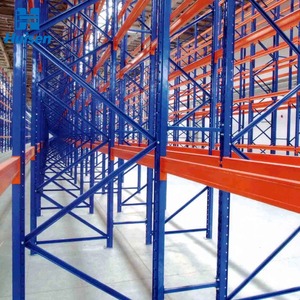
Pallet racking systems are classified as specialized civil and mechanical structural installations. Unlike static shelving, high-bay racking systems absorb massive static dead weights, dynamic live loads generated by forklift material handling equipment, and seismic accelerations. When procuring wholesale pallet racking from China, procurement engineers and supply chain directors must evaluate the mechanical yield strength, metallurgy, and roll-forming precision of the cold-formed steel sections.
Our manufacturing facility utilizes high-tensile Q235B and Q355B structural hot-rolled coil steel sourced directly from tier-one domestic steel mills such as Baosteel and Shougang. Steel coils are cold-rolled via multi-station automated continuous roll-forming lines to achieve precise cold-work hardening. This process elevates yield strengths (σy ≥ 235–355 MPa) while preserving core ductility for dynamic energy dissipation in seismic zones.
Selecting the optimal storage density requires balancing SKU diversity, inventory picking velocity, and handling equipment capabilities. Below is an engineering comparison of the primary industrial racking configurations produced for international export:
The core structural integrity of an industrial pallet racking bay depends on the geometry of the upright column profile. Our factory utilizes a continuous 13-to-18-stage precision cold-roll-forming line that cold-forms cold-rolled strip steel into an omega (Ω) multi-rib cross-section. The presence of multiple cold-rolled stiffening folds along the web and flanges significantly elevates the member's polar moment of inertia, inhibiting torsional-flexural buckling and local web distortion under concentrated vertical axial loads.
Upright punching is executed by hydraulic CNC automated punching dies prior to roll-forming. This guarantees pitch tolerances within ±0.5mm across a continuous 12-meter single-piece upright frame. International buyers can specify pitch geometry to mirror regional fleet configurations:
50mm / 75mm Pitch (Euro/International Standard): Engineered with multi-hook heavy-duty locking claws. Connector tabs feature reverse tapered geometry that wedges tighter as the downward gravity load of the pallet increases.
76.2mm (3-Inch) Teardrop System (North American Standard): Universal compatibility with teardrop uprights, incorporating high-tensile spring-loaded automatic safety locking pins resistant to upward fork displacement forces exceeding 5.0 kN.
Beam Welded Box Profiles & Finite Element Deflection Limits
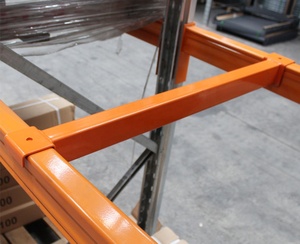
Pallet rack horizontal load beams are engineered using twin cold-formed "C"-sections interlocking into a hermetically welded box profile. Robotic GMAW (Gas Metal Arc Welding) fixtures fuse the box beam to the multi-claw high-ductility end connectors. In strict accordance with EN 15512:2020 and ANSI MH16.1, our engineering design dictates a structural deflection limit under full safe working load (SWL) not exceeding:
δ ≤ L / 200 (European Standard) | δ ≤ L / 180 (North American Standard)
Where L represents the clear distance between upright faces. To ensure total structural safety, every batch undergoes destructive three-point load testing and cantilever cyclic deflection analysis to verify that the factor of safety against ultimate plastic collapse remains greater than or equal to 1.50.
Factory Direct Value Chain
Why International Integrators Source Directly from China
By eliminating trading intermediaries, global third-party logistics (3PL) providers, warehouse contractors, and procurement distributors unlock significant economic and technical efficiencies.
Mill-Direct Metallurgy & Raw Material Hedging
Direct supply contracts with certified Chinese primary steel mills allow bulk raw material procurement at baseline indices. Mill Test Certificates (MTC conforming to EN 10204 3.1) verify carbon equivalence, phosphorus, sulfur limits, and yield ratings for every production coil batch.
Digital CAD Layout & 3D FEA Simulation
Our in-house structural engineering department generates full building clearance drawings, forklift sweep path simulations, and 3D ANSYS Finite Element Analysis (FEA). We model second-order sway buckling effects (P-Delta analysis) under dynamic seismic and wind load envelopes.
Continuous Automated Surface Finishing
Components pass through an automated 7-stage pre-treatment line: degreasing, zinc-phosphate conversion, and deionized water rinsing. Electrostatic thermosetting powder coating (70–90 μm) cured at 200°C ensures 500+ hours of continuous salt-spray resistance (ASTM B117).
Strategic Sourcing Whitepaper • Section 02
Future Sourcing Trends: The Transition to High-Density Automation
As commercial warehouse real estate rents surge globally across the United States, Europe, the Middle East, and Southeast Asia, warehouse developers can no longer justify the expansive footprint consumed by traditional low-density wide-aisle (VNA/Selective) storage. The global intralogistics sector is experiencing an irreversible structural shift toward High-Density Automated Storage and Retrieval Systems (AS/RS) and semi-automated four-way radio shuttle systems.
Pallet Runner Automation
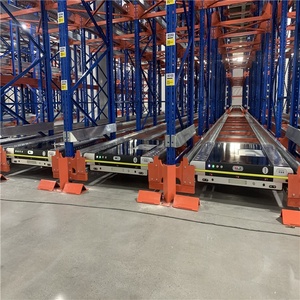
Shuttle systems replace forklift aisles with continuous channel tracks. Battery-powered shuttle cars travel autonomously inside storage lanes, lifting and transporting pallets at speeds up to 1.2 m/s under wireless WMS command.
Rack-Supported Buildings
The racking framework itself functions as the primary structural skeleton of the warehouse facility. High-bay AS/RS upright columns directly support roof purlins and wall insulated sandwich cladding, slashing civil construction costs by up to 25%.
Container Freight Density
Modern export-oriented racking engineering prioritizes container cube utilization. Knock-down modular upright frames and nesting beam profiles allow 40-foot High Cube (40'HQ) shipping containers to pack up to 24-26 metric tons of steel without volume wastage.
Cold Chain Metallurgy
Expanding temperature-controlled pharmaceutical and frozen food logistics demand specialized low-temperature steels. Standard Q235B exhibits ductile-to-brittle transition below -10°C. We supply fine-grained Q355D/E with verified Charpy V-notch impact toughness at -30°C.
Quality Assurance & Third-Party Testing Protocols
For large-scale international warehouse tenders, engineering teams require rigorous physical verification before releasing export shipments. Our China factory maintains a dedicated QA test tower capable of executing full-scale compressive frame tests up to 500 kN, stub-column axial tests, and connector looseness dynamic tests in compliance with EN 15512 Clause 9. Third-party visual and non-destructive testing (NDT), such as ultrasonic weld inspection and magnetic particle testing (MT) conducted by SGS, TÜV Rheinland, or Bureau Veritas, is seamlessly coordinated prior to container stuffing.
What are the principal differences between EN 15512, ANSI/RMI MH16.1, and AS 4084 standards?
While all three standards govern the structural design and safe utilization of industrial steel static storage systems, their limit state design philosophies, safety factor allocations, and seismic provisions vary:
EN 15512 (European Union): Operates on Limit State Design (LSD) principles. It requires extensive laboratory testing of specific components (stub column, upright-beam connector rotational stiffness, floor baseplate hinge rigidity) and explicitly models global and local frame imperfections.
ANSI/RMI MH16.1 (United States): Based on Load and Resistance Factor Design (LRFD) or Allowable Strength Design (ASD) methodologies. It integrates specific AISC structural steel rules and mandates seismic design compliant with ASCE 7 and IBC (International Building Code).
AS 4084:2023 (Australia): Recently updated to mirror the European LSD framework while retaining distinct Australian safety factor margins and stricter seismic / impact allowance margins.
Our manufacturing facility designs and rolls racking members tailored specifically to the structural standard legally mandated in your project's jurisdiction.
What floor slab specifications and concrete strengths are required for heavy-duty racking?
Industrial racking transmits point loads through baseplates to the concrete warehouse floor slab. For bays storing 2,000 to 3,000 kg per level across multiple tiers, total upright frame point loads often range between 80 kN and 180 kN. Slabs typically require a minimum compressive strength of C20/25 (minimum 25 MPa cylinder strength), with heavy installations requiring C28/35 or C30/37 (30 to 35 MPa).
Floor flatness is also critical: standard narrow aisle (VNA) operations mandate floor tolerances conforming to DIN 18202 Table 3 Line 4 or TR34 (Category Free Movement FM1/FM2) to prevent excessive forklift mast sway at extended lift heights.
How do you determine beam level capacity versus total bay frame capacity?
Beam Capacity: Calculated on the premise of a uniformly distributed load (UDL) acting on a pair of horizontal beams supported at their end connectors. Capacity is governed by the section modulus of the box profile and the allowable vertical deflection (≤ L/200).
Bay Frame Capacity: The vertical compressive load an upright frame can support is non-linear and depends inversely on the unsupported beam pitch (vertical distance between beam levels). A frame rated for 18,000 kg with beams spaced at 1,500 mm pitch may have its total capacity reduced to 12,500 kg if the first bottom beam level is raised to 2,200 mm to clear a ground-level walk-through passage. Frame buckling length (Euler column behavior) dictates total structural capacity.
When should hot-dip galvanized finish be specified over electrostatic powder coating?
Electrostatic Powder Coating (Epoxy-Polyester Hybrid): The standard industry finish for indoor, dry warehouse environments. It provides superior mechanical abrasion resistance against pallet scuffing, excellent aesthetic branding options, and long-term durability in ambient relative humidity below 70%.
Hot-Dip Galvanizing (ISO 1461): Involves immersing cleaned fabricated steel into molten zinc at 450°C, creating a metallurgically bonded zinc-iron alloy coating (minimum 65–85 μm thickness). Specify hot-dip galvanizing for: outdoor uncovered storage yards, high-salinity coastal marine ports, chemical processing facilities with corrosive acid/alkali vapors, or blast-freezer operations subject to aggressive condensation and washdown cycles.
How do you package and protect pallet racking components for ocean container shipping?
International sea freight exposes steel components to vibration, moisture condensation ("container rain"), and rough handling. Our factory implements an engineered packaging system:
Upright Frames: Shipped as knocked-down (KD) upright posts, horizontal braces, and diagonal bracing bundles wrapped in corrugated protective card and heavy-gauge PE stretch film, strapped with high-tensile PET banding over timber dunage.
Box Beams: Stacked in uniform bundles with wooden separator blocks preventing metal-to-metal contact and claw connector distortion during transit.
Small Hardware: Baseplates, beam safety pins, anchor bolts, and shims are packed in heavy-duty reinforced wooden crates or double-walled corrugated cartons strapped to fumigated ISPM-15 export pallets.
What data must the client supply for a comprehensive warehouse racking layout design?
To produce an optimized CAD proposal and load calculation report within 24 to 48 hours, our technical design department requires:
Warehouse Architectural Plan (CAD / PDF): Showing internal building perimeter dimensions, structural building column grid positions, dock door locations, and lower clearance heights beneath overhead obstacles (fire sprinkler pipe arrays, lighting, HVAC ducts).
Pallet Load Data: Pallet dimension (Length × Width × Overall Height inclusive of cargo), pallet type (EUR 1200×800mm, Industrial 1200×1000mm, US 48"×40"), and maximum gross weight per unit load.
Material Handling Equipment (Forklift Model): Forklift type (Counterbalance, Reach truck, VNA turret truck), maximum lift height, and manufacturer-specified minimum right-angle stacking aisle width (Ast).
Seismic & Environmental Factors: Site geographic location, soil category, and local building code requirements.
How do you manage international installation and on-site assembly supervision?
We provide two flexible installation support models for international buyers and general contractors:
Remote Engineering Support: Detailed 3D isometric assembly drawings, color-coded bay elevation diagrams, bolt torque specification sheets, and video installation guides. Every component is labeled with batch and tag references matching the layout plan.
On-Site Lead Installation Supervisors: Dispatch of experienced bilingual mechanical installation engineers to oversee local labor teams, ensure laser leveling, manage baseplate anchor torque verification, and conduct final handover inspection in compliance with EN 15635 guidelines.
What are the periodic rack inspection guidelines under EN 15635 (Green, Amber, Red limits)?
European Standard EN 15635 (Steel Static Storage Systems – Application and Maintenance of Storage Equipment) categorizes rack damage into three operational action levels based on steel deformation tolerances:
Green Level: Deformation within acceptable manufacturing tolerances. Requires ongoing scheduled surveillance without immediate load reduction.
Amber Level (Hazardous Damage): Permanent deflection exceeds standard limits (e.g., upright bend > 3.0mm measured over a 1-meter gauge length in the plane of the frame). Action: Affected bays must be unloaded within 4 weeks and components replaced; no new pallets may be loaded onto the damaged section.
Red Level (Very Serious Hazard): Severe deformation (e.g., upright lateral bend > 6.0mm or ripped beam welds). Action: Immediate offloading of all pallets on the affected and adjacent bays, physical barrier cordon-off, and replacement before re-commissioning.
We supply replacement uprights, beams, column protectors, and load capacity warning signage designed to keep your facility compliant.
Connect Directly with Our Structural Engineering Team
Send your warehouse architectural drawings, pallet load specifications, and handling equipment parameters. Our engineering department will deliver an optimized CAD layout plan, load calculation schedule, and factory-direct wholesale quotation within 24 hours.