
No matching pages. Try "pallet", "mezzanine" or "cantilever".
No matching pages. Try "pallet", "mezzanine" or "cantilever".
Verified structural steel components manufactured to international FEM 10.2.02, EN 15512, and RMI standards. Designed for seamless containerized export and extreme payload durability.
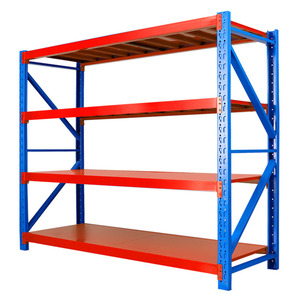
Precision-punched teardrop and box-beam connections offering rapid assembly and flexible vertical level adjustment on a 50mm pitch.
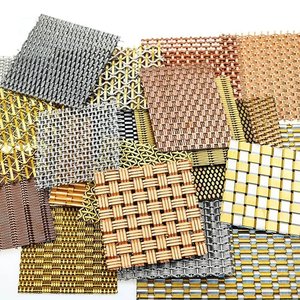
Rigid flare-waterfall galvanized wire mesh safety decks engineered for beam support, sprinkler water penetration, and item anti-drop safety.
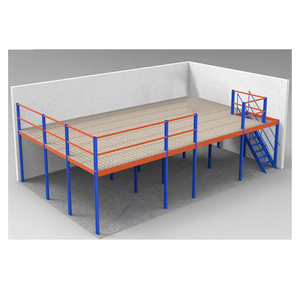
Multi-tier structural column-supported mezzanine systems multiplying usable footprint without building extension. High load ratings for industrial staging.
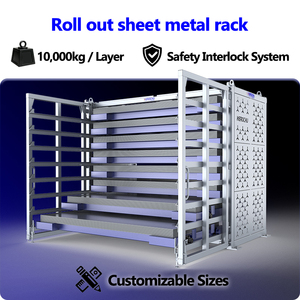
High-load vertical storage frames featuring reinforced omega uprights, certified interlocking safety locks, and high torsional resistance for VNA operations.
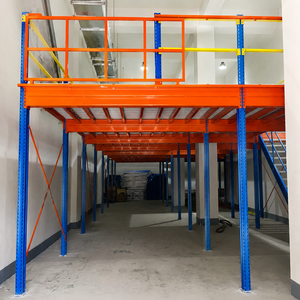
Integrated racking mezzanine utilizing racking uprights as vertical pillars, complete with safety handrails, pallet pivot gates, and industrial staircases.
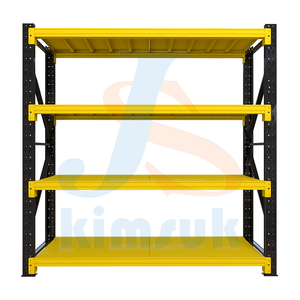
Engineered for e-commerce picking and dense manual inventory workflows. Features interlocking cold-rolled light steel beam structures and noise-damped panels.
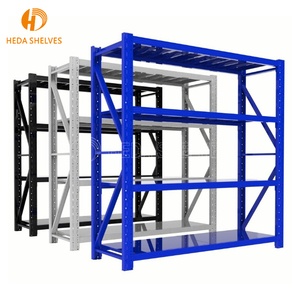
Cold-formed structural profile shelving suitable for dense parts fulfillment, automotive distribution, and heavy cartons requiring rapid manual selectivity.
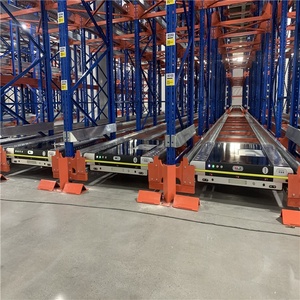
Intelligent electric pallet runner integration inside narrow lane profiles. Maximizes storage volume while eliminating forklift travel inside storage channels.
In high-throughput global supply chains, industrial floor real estate is the single largest ongoing operating expense. Narrow Aisle (NA) and Very Narrow Aisle (VNA) racking systems bridge the gap between pure high-density block storage and 100% individual pallet selectivity.
Standard wide-aisle counterbalance racking requires working aisle widths between 3,200 mm and 3,800 mm. Very Narrow Aisle (VNA) configurations condense this corridor down to 1,500 mm – 1,800 mm. By compressing transit dead-space, facilities reclaim up to 45% of floor footprint while extending upward to 18 meters.
Unlike Drive-In, Push-Back, or Gravity Pallet Flow racks which mandate strict FIFO or LIFO inventory sequences and suffer from honeycomb space losses, VNA preserves instant direct access to every single pallet position. This is mandatory for operations carrying 5,000+ distinct high-value SKUs.
Because clearances between pallet loads and upright frames inside VNA runs measure as narrow as 100mm, human steering error is completely engineered out. VNA systems integrate heavy-duty rolled profile bottom guide rails or subterranean wire inductive frequency loops to lock truck guidance on a laser-straight axis.
| System Architecture | Operating Aisle Width | Maximum Lift Height | Floor Space Utilization | Pallet Selectivity | Primary Material Handling Equipment |
|---|---|---|---|---|---|
| Very Narrow Aisle (VNA) | 1,500 mm – 1,850 mm | Up to 18.5 Meters | Exceptional (90%) | 100% Direct (Unrestricted) | Man-Up / Man-Down Turret Trucks, Articulated VNA |
| Standard Selective Racking | 3,200 mm – 3,800 mm | Up to 11.5 Meters | Standard (45-50%) | 100% Direct | Standard Counterbalance Forklift, Reach Truck |
| Double-Deep Pallet Rack | 3,000 mm – 3,400 mm | Up to 11.0 Meters | Moderate (65%) | 50% Direct (LIFO per 2 pallets) | Specialized Pantograph Reach Truck |
| Drive-In / Drive-Through | Lane Dependent (Dense) | Up to 12.0 Meters | Very High (80%) | Low (Last-In, First-Out) | Narrow-Chassis Counterbalance or Reach Truck |
| Radio Shuttle Automation | Dense Storage Channels | Up to 22.0 Meters | Maximum (95%) | Channel Batched (FIFO/LIFO) | Automated Radio Shuttle Carrier + Forklift / Stacker Crane |
As a leading narrow aisle racking exporter, our structural calculations do not simply evaluate static yield stress—we design for the dynamic harmonic amplification that occurs when a 1,500 kg turret truck operates at an elevation of 16 meters.
Even a 1-millimeter floor slab imperfection is magnified eighteen-fold at the top mast level. For this reason, high-bay VNA installations demand strict adherence to international civil and structural tolerances.
Procurement directors and supply chain engineers are no longer purchasing static steel frames; they are specifying dynamic modular foundations designed to integrate with automated and autonomous warehouse ecosystems over a 15-year lifecycle.
The global shortage of licensed turret truck operators is driving a major pivot toward automated guided VNA vehicles (VNA-AGVs). Modern racking systems must feature ultra-precise laser target mounting points, millimeter-accurate beam level tolerances, and integrated clearance sensors.
Future-ready procurement frameworks demand integrated smart sensors embedded at bottom upright bases and aisle corners. These tri-axial accelerometers detect subtle forklift impact events in real time, notifying facility management via cloud dashboards before micro-fatigue triggers structural collapse.
With refrigerated warehouse energy costs climbing drastically, narrow aisle cold-room storage has become imperative. Exporters now formulate specialized low-temperature alloy steels and ductile cold-resistant powder coatings that do not embrittle or chip under -30°C thermal conditions.
Multinational EPC contractors and global brands enforce strict Scope 3 ESG supply chain quotas. Our production mills utilize electric arc furnace (EAF) processed steel with verified recycled scrap ratios, cutting embedded product carbon footprint by up to 38% compared to blast-furnace profiles.
As an international manufacturing exporter supplying major projects across the UAE, Middle East, Europe, and the Americas, our end-to-end operational workflow eliminates international procurement risk from CAD drafting to final site commission.
State-of-the-art computer-controlled cold-roll forming production lines with real-time laser perforation accuracy ensuring zero deviation across 18-meter continuous single-piece upright sections.
Our dedicated engineering department provides detailed 3D Building Information Modeling (BIM) files, floor slab anchoring layouts, building column clash analysis, and complete sprinkler clearance reviews.
International containerization requires rigorous logistics engineering. All uprights and beams are bundled with steel strapping, moisture-barrier wrapping, corner edge protectors, and specialized wooden saddles for fork unloading.
Engineering compliance verified to European EN 15512, Australian AS4084, and US RMI MH16.1 codes, backed by certified structural calculations formatted for swift local authority and Civil Defence submission.
A multi-stage chemical degreasing, iron phosphate cleaning, and deionized water rinse followed by high-adhesion electrostatic thermosetting epoxy-polyester powder coating guarantees long-term corrosion resistance.
Every exported project includes complete as-built installation schematics, step-by-step assembly sequence guides, torque charts, and UV-laminated steel load capacity signage compliant with EN 15635 standards.
Authoritative answers to the most critical technical and logistical questions faced by warehouse facility managers, EPC contractors, and international procurement teams.
Because Very Narrow Aisle turret trucks operate with minimum physical clearance at elevated heights, standard commercial floor slabs are inadequate. VNA installations must comply with the German DIN 15185 standard, the British Concrete Society TR34 (Class DM1 or DM2 depending on top beam elevation), or the American ACI F-min specification (F-min 75 to 100). The floor along the designated wheel tracks must be surveyed using specialized transverse and longitudinal profilers. Where floor variations exceed 1.5mm across the truck track width, professional laser floor grinding or specialized self-leveling polymer screeds must be installed prior to racking erection.
Both systems ensure forklifts travel safely within 1,600mm aisles without operator steering. Mechanical Guide Rails utilize low-profile steel structural angles (typically L100x75x8 or L125x75x10) or heavy-duty tubular rails anchored to the floor slab along the bottom beam run. They provide an unyielding physical crash barrier that protects upright frames from bottom-level chassis impact. Wire Induction Guidance involves cutting a shallow 4mm x 15mm groove in the concrete center line and embedding a low-voltage high-frequency copper conductor wire. Wire guidance eliminates trip hazards, allows easier low-level manual hand picking, and simplifies floor cleaning, but requires fail-safe electronic guidance sensors on the truck and pristine slab reinforcement layout.
Racking frames over 11.8 meters in length cannot fit into standard 40ft High Cube ocean shipping containers as pre-assembled monolithic weldments. As an experienced exporter, we engineer precision splice-joint connections tested and certified under EN 15512 to ensure 100% structural moment continuity. Upright columns are nested tightly to maximize container weight capacity (typically 24–26 metric tons per 40HQ), bound with high-tensile steel strapping over heavy edge protectors, wrapped in moisture-resistant vapor barrier polyethylene, and resting on custom-cut hardwood dunnage. Beams are stacked in interlocking paired layers with foam separators to prevent paint abrasion during transit.
Standard reach trucks typically require a minimum clear aisle width of 2,700 mm to 3,000 mm to rotate 90 degrees and deposit a 1,200mm deep pallet. If an aisle is reduced below 2,000 mm, standard reach trucks cannot turn. VNA layouts require specialized equipment: either Man-Down Turret Trucks, Man-Up Combi Order Pickers (where the operator cab ascends with the forks for high-bay piece picking), or Articulated Very Narrow Aisle Forklifts (such as Bendi or Flexi style trucks) whose front chassis pivots 180 degrees to work within aisles as narrow as 1,800 mm without requiring guide rails.
To produce an authoritative structural proposal and CAD layout, our engineering team requires six foundational parameters: (1) Pallet Specifications: Width, depth, overall height including cargo overhang, and maximum loaded gross weight; (2) Clear Warehouse Height: Distance from finished floor level to the lowest underside ceiling obstruction (HVAC, light fixtures, fire sprinklers); (3) Floor Slab Details: Concrete compressive strength (e.g., C25/30, C30/37), slab thickness, and reinforcement mesh data for anchor pull-out ratings; (4) Forklift Specification Sheet: Turning radius, collapsed mast height, maximum reach elevation, and chassis width; (5) Environmental Factors: Local seismic acceleration coefficients and site wind loads (for outdoor installations); (6) Throughput Target: Pallets per hour inbound and outbound.
Our manufacturing and export processes operate under ISO 9001 quality management, ISO 14001 environmental management, and ISO 45001 occupational safety frameworks. All industrial racking systems comply with CE mark requirements under EN 1090-1 execution of steel structures, with engineering design verified according to European standard EN 15512, installation tolerances to EN 15620, and operational maintenance standards adhering to EN 15635. Full mill test certificates (MTC 3.1) verifying steel chemical composition and tensile elongation are provided with every export shipment.
Submit your warehouse CAD drawings, pallet dimensions, and handling vehicle parameters. Our senior structural logistics engineers will calculate exact bay loadings, aisle clearances, and provide a full export quotation within 24 hours.