
No matching pages. Try "pallet", "mezzanine" or "cantilever".
No matching pages. Try "pallet", "mezzanine" or "cantilever".
Direct supply from leading Chinese automated manufacturing facilities. Fully interchangeable with North American 2-inch pitch teardrop patterns, tested to rigorous seismic and cyclical stress tolerances.
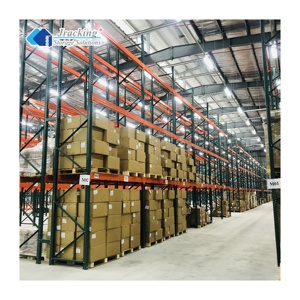
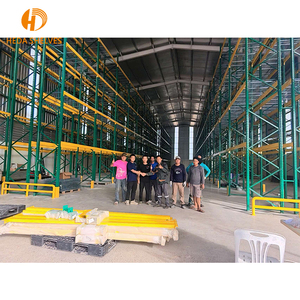
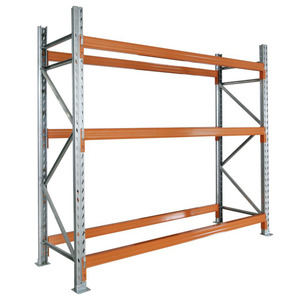
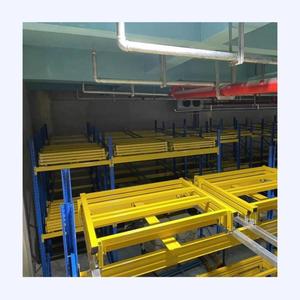
A structural engineering evaluation of cold-formed steel punch-hole geometries, mechanical interlock physics, and manufacturing quality control parameters.
The hallmark of the American-style teardrop profile is the inverted keyhole geometry stamped along the upright column face on a standardized 2.0-inch (50.8 mm) incremental pitch. When a step beam end-connector rivet enters the wide aperture and slides down into the narrow neck, gravity works synergistically with payload weight.
As pallet weight increases, the mechanical shear wedging effect intensifies, preventing unseating during high-velocity forklift placement while maintaining quick adjustability without field bolting.
Tier-one Chinese racking factories utilize prime hot-rolled and cold-rolled strip steel, predominantly Q235B and high-strength Q355B (equivalent to ASTM A36 and ASTM A1011 Grade 50). Using multi-station continuous roll-forming lines (18 to 24 roll stations), residual stresses are systematically eradicated.
Upright column profiles exhibit uniform wall thicknesses (12 Gauge / 2.5 mm, 14 Gauge / 1.9 mm, 15 Gauge / 1.8 mm, and 16 Gauge / 1.5 mm), engineered to satisfy the AISI S100 North American specification for cold-formed steel structural members.
To eliminate accidental beam dislodgement caused by erratic forklift operator elevation (ANSI MH16.1 uplift mandate requiring min. 1,000 lbs upward resistance), Chinese manufacturers incorporate precision-stamped locking systems.
Options include integrated spring-loaded piston locks or heavy-duty drop-in J-pins. In seismic zones, beam connectors utilize 3-rivet or 4-rivet extended plates with reinforced secondary shear pins, preventing rotational moment release under cyclic earthquake excitation.
Reference data calculated under ANSI MH16.1-2021 specifications for industrial steel storage racks with a minimum safety factor of 1.67:1. Capacities depend on beam vertical spacing (unsupported length) and steel grade.
| Profile Designation | Material Grade | Wall Thickness | Vertical Spacing (in) | Max Frame Capacity (lbs) | Typical Beam Application | Compliance Standards |
|---|---|---|---|---|---|---|
| UP-3016 (3" x 3") | Q235B / ASTM A36 | 16 GA (1.5 mm) | 48" Beam Spacing | 19,800 lbs | Light-to-Medium Distribution | ANSI MH16.1 / CE |
| UP-3014 (3" x 3") | Q235B / Gr. 50 | 14 GA (1.9 mm) | 48" Beam Spacing | 27,500 lbs | Standard Distribution (FMCG) | RMI / ISO 9001 |
| UP-3012 (3" x 3") | Q355B / High Yield | 12 GA (2.6 mm) | 48" Beam Spacing | 38,400 lbs | Heavy Industrial / Seismic Zone 4 | Seismic IBC / RMI |
| SB-35 (Step Beam) | Q235B Dual C-Weld | 16 GA (1.5 mm) | Span: 96" (2-Pallet) | 4,100 lbs / Pair | 1,000 kg standard Euro/US pallet | L/180 Deflection |
| SB-45 (Step Beam) | Q235B Dual C-Weld | 14 GA (1.9 mm) | Span: 96" (2-Pallet) | 6,200 lbs / Pair | 1,500 kg heavy manufacturing loads | L/180 Deflection |
| SB-55 (Step Beam) | Q355B Structural | 14 GA (1.9 mm) | Span: 108" (3-Pallet) | 8,500 lbs / Pair | Beverage, Petrochemical, Drums | RMI Heavy Duty |
| SB-60 (Box Beam) | Continuous Seam Tube | 12 GA (2.6 mm) | Span: 144" (Wide Bay) | 11,200 lbs / Pair | Push-back, High-density Pallet Flow | Heavy Dynamic |
Note: Deflection limit is strictly governed by $L/180$ under maximum uniformly distributed load (UDL). Seismic anchor sizing requires structural PE stamp based on local site soil class and geotechnical spectra.
How automation, decarbonization policies, and structural engineering software are transforming the industrial pallet rack procurement landscape.
To offset trans-oceanic freight inflation, Chinese factories increasingly deploy ultra-high-yield steels (e.g., Q355B, Q460). By elevating yield strength from 235 MPa to 355+ MPa, column and beam wall thicknesses can be reduced by 12% to 18% without sacrificing structural bay capacities.
This yield-optimized geometry reduces gross metric tonnage per 40ft High Cube (40HQ) container, maximizing the volume-to-weight ratio and reducing per-pallet landed logistics costs.
With North American and European ESG reporting intensifying, tier-one Chinese suppliers are shifting from coal-based blast furnaces to Electric Arc Furnace (EAF) steel sourcing. Direct factories provide Environmental Product Declarations (EPDs) and verify emissions per ton of fabricated rack.
Additionally, automated heavy-metal-free zirconium pretreatment combined with low-bake TGIC-free polyester powder coatings is replacing older zinc-phosphate dipping baths to satisfy strict municipal and international environmental audits.
Modern distribution centers no longer purchase standalone manual racks. Procurement specifications require teardrop racking to support high-speed Automated Mobile Robots (AMRs), wire-guided reach trucks, and 4-way shuttle systems.
This requires millimeter-precise verticality tolerances (exceeding standard EN 15620 class 400), precision-milled baseplates with recessed anchor bolts, and laser-guided ground track integration for automated order fulfillment.
An objective audit of automated roll forming lines, robotic welding stations, pre-treatment finishing, and structural testing labs.
Top-tier Chinese facilities feature fully automated, continuous roll-forming production lines controlled by Omron/Siemens PLC systems. The teardrop punching process occurs prior to roll forming using high-tonnage mechanical presses fitted with carbide progressive tooling.
This guarantees an absolute punch pitch tolerance within ±0.1 mm over a 12-meter continuous column, ensuring that beam connectors from different production batches interlock without binding, warping, or axial misalignment.
Step beam and box beam manufacturing utilizes six-axis ABB or FANUC robotic welding cells. Upright end-connectors are joined to the beam section using dual-sided submerged arc or metal active gas (MAG) welding with ER50-6 high-tensile wire.
Robotic consistency eradicates human error, cold-lap flaws, and porosity. Weld penetration undergoes routine non-destructive examination (NDE), including cross-sectional etching and ultrasonic testing to verify fatigue life under cyclical dynamic pallet impacts.
The primary cost driver in international pallet rack procurement is shipping volume. Unbundled upright frames take up excessive container space. Top Chinese manufacturers apply advanced container loading optimization (CLO) algorithms:
Authoritative, engineering-backed answers addressing international logistics, structural certifications, metallurgical equivalence, and installation tolerances.
Yes. Chinese top-tier manufacturers design and roll-form to the classic American universal teardrop profile with an exact 2-inch (50.8 mm) center-to-center hole pattern. Beam connectors from Chinese manufacturers interlock seamlessly with existing upright frames from major North American manufacturers, including Interlake (original teardrop), SpaceRak, Ridg-U-Rak, and Bulldog.
However, when mixing components across manufacturers, structural engineers must verify that the beam connector rivet shoulder diameter matches the column face cut-out, and that the auto-lock pin registers properly in the alignment hole to ensure compliance with ANSI MH16.1 uplift requirements.
Chinese steel standards (GB/T 700 and GB/T 1591) correlate directly with ASTM classifications used in North American structural engineering. Q235B has a minimum yield strength of 235 MPa (approx. 34,100 psi), which closely matches ASTM A36 and ASTM A1011 CS Type B.
Q355B offers a minimum yield strength of 355 MPa (approx. 51,500 psi), serving as an exact equivalent to ASTM A1011 HSLA Grade 50 or ASTM A572 Grade 50. Top Chinese exporters provide original Mill Test Certificates (MTC) per EN 10204 3.1 detailing chemical composition (carbon, manganese, phosphorus, sulfur limits) and Charpy V-notch impact test values with every production heat.
Export-oriented Chinese manufacturers maintain ISO 9001, ISO 14001, and CE certification (EN 1090-1 execution of steel structures). For North American projects, reputable factories retain independent US-licensed Professional Engineers (PE) who generate finite element analysis (FEA) calculations, seismic baseplate calculations, and stamped drawings compliant with the International Building Code (IBC) and ASCE 7 seismic parameters.
Physical testing reports—including beam-to-column connection stiffness (rotational spring constant $F$), column stub compression, and floor anchor pull-out—are performed in certified testing laboratories under RMI MH16.1 test procedures.
For oceanic container shipping, Knocked-Down (KD) bolted frames are strongly recommended. A standard 40ft High Cube container can hold only 90 to 120 pre-welded upright frames due to internal air voids (hitting the container volumetric cube limit at only 11–13 tons).
Conversely, KD bolted frames allow upright columns, horizontal braces, and diagonal struts to be densely nested on timber runners. A single 40HQ container can accommodate 350 to 500 complete KD frames, packing the container to its maximum allowable gross road weight (25–26 metric tons). This cuts per-frame oceanic freight costs by up to 60%, more than compensating for on-site frame assembly labor.
Professional Chinese suppliers conduct a multi-stage Quality Assurance protocol: (1) Incoming raw material audit using optical emission spectrometers to verify steel chemistry and tensile test benches to verify yield points; (2) In-line dimensional auditing checking teardrop punch pitch accuracy (±0.1 mm), beam roll-form profile camber, sweep, and twist (<1.0 mm per meter); (3) Coating quality testing encompassing cross-hatch adhesion testing (ASTM D3359 Class 5B), coating thickness verification (electromagnetic gauge, 60–90 μm), and 500-hour neutral salt spray testing (ASTM B117); (4) Trial mock-up assembly on the factory floor to ensure beam locks and safety pins engage smoothly.
Standard lead times for full container load (FCL) orders (1 to 5 containers) average 20 to 30 calendar days following technical drawing sign-off and receipt of deposit. High-capacity projects (20+ containers) are typically phased with rolling shipments starting at week 4 and completing across 60–90 days.
Standard payment terms for international buyers are 30% T/T deposit upon purchase order confirmation and CAD layout approval, with the remaining 70% balance paid against presentation of original Bill of Lading (B/L), packing lists, and commercial invoices, or via Irrevocable Letter of Credit (L/C at sight).
Combining automated production, finite element analysis (FEA), and global logistics engineering for international distribution partners and system integrators.
Experienced rack design teams provide detailed layout drafting, picking aisle clearance verification, forklift turning radius analysis, and pallet load distribution models. Every project is reviewed to balance static cubic density with operational throughput efficiency.
Equipped with Swiss Gema automated electrostatic powder spray booths and multi-zone curing ovens. We offer custom RAL colors for rapid brand integration, and exterior-grade hot-dip galvanizing (ISO 1461) or pre-galvanized components for sub-zero cold storage and outdoor yard racks.
Every shipment includes numbered component tags, detailed installation manuals, load notices, and 3D exploded assembly diagrams. For large-scale projects, experienced technical supervisors can be dispatched globally to oversee local installation and commissioning.
Send your warehouse architectural CAD plans, pallet load specifications, and clear height dimensions. Our structural engineers will prepare an optimized layout drawing and transparent direct-factory quote within 24 hours.