No matching pages. Try "pallet", "mezzanine" or "cantilever".
Top Trusted Freezer Racking Systems Supplier & Suppliers
Precision-Engineered Sub-Zero Industrial Storage Infrastructure: Certified for Extreme Temperatures Down to -30°C with High-Density Automation
Cold-Chain Product Lineup
High-Performance Cold Storage & Industrial Racking Systems
Engineered to mitigate cold-brittleness, maximize cubic thermal density, and guarantee flawless pallet movement in blast chillers, sub-zero holding chambers, and refrigerated 3PL facilities.
The Thermodynamics of Sub-Zero Racking: Engineering Beyond Ambient Warehousing
Operating an industrial racking system within a refrigerated or sub-zero blast freezer environment presents severe mechanical, metallurgical, and thermodynamic challenges that standard ambient warehouse calculations fail to address. In a deep-freeze environment operating between -18°C and -30°C, refrigerated air represents the most significant ongoing operational expense. Consequently, the primary engineering objective of any freezer racking supplier is twofold: maximizing volumetric storage density to drive down the cost of refrigeration per pallet position, while simultaneously guaranteeing metallurgical resilience against ductile-to-brittle steel transitions under dynamic forklift impact.
"In cold-storage logistics, every cubic meter of unoccupied air is an active utility penalty. Sub-zero racking is not merely static steel shelving; it is a thermal-management instrument that dictates evaporator air-flow velocity, structural safety, and operational lifecycle."
Standard structural carbon steels (such as conventional commercial-grade Q235B or ASTM A36) experience a dramatic drop in impact toughness as operating temperatures dip below 0°C. At blast freezer temperatures down to -30°C, ordinary carbon steel reaches its Ductile-to-Brittle Transition Temperature (DBTT). Under this cryogenic state, the steel lattice can no longer absorb energy through plastic deformation; instead, minor operational bumps from material handling equipment (MHE) can precipitate immediate brittle shear fractures, leading to catastrophic bay collapse.
As an authoritative freezer racking manufacturer and supplier, our engineering protocols mandate the use of micro-alloyed, killed structural steels such as Q355D, Q355E, or European Standard EN 10025 S355J2/K2. These alloys are enriched with trace amounts of manganese, niobium, or vanadium and undergo controlled thermo-mechanical rolling to refine grain boundaries. Each production lot is verified through standard Charpy V-notch (CVN) impact testing, certifying a minimum impact energy absorption of 27 Joules at -20°C and -40°C. This guarantees that our upright frames, load-bearing cross beams, and locking connectors maintain sufficient structural ductility to endure sustained static loads and accidental impact dynamics in sub-zero chambers.
2. Volumetric Cubic Density vs. Thermal Airflow Circulation
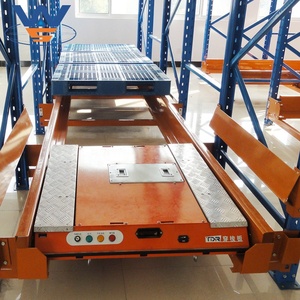
High-density racking configurations—specifically Radio Pallet Shuttle, Drive-In Racking, and Mobile Racking—eliminate unnecessary operating aisles, achieving cubic storage efficiencies up to 85% compared to 40% for conventional selective racks. However, compressing storage density without computational thermal planning creates localized "heat islands" and cold dead-zones.
Our layout design engineers coordinate with refrigeration mechanical consultants to establish strict clearance buffers: a minimum 400mm clearance from cold evaporator coils, 150mm vertical flue spaces, and longitudinal flue gaps between pallet rows. This layout preserves continuous laminar air circulation, ensuring uniform sub-zero temperature distribution across frozen seafood, ice cream, poultry, and pharmaceuticals while minimizing compressor cycling time.
3. Comparative System Matrix: Selecting the Right Freezer Racking Typology
Racking Topology
Storage Density
Selectivity / Access
Stock Rotation
Forklift Exposure in Cold
Ideal Freezer Application
Automated Radio Shuttle
Very High (85%)
Lane-Dependent
FIFO or LIFO
Zero (Loads at Aisle Face)
High-throughput frozen foods, 3PL bulk holdings
Drive-In Racking
High (70%)
Low (Last In First Out)
Strict LIFO
High (Drives inside rack lanes)
Homogeneous seasonal stock, low SKU variety
Electric Mobile Racking
Very High (90%)
100% Direct on Open Aisle
Flexible FIFO/LIFO
Low (Standard reach truck)
High SKU variety, pharmaceutical cold vaults
Double Deep Pallet Racks
Medium-High (60%)
50% Direct Access
LIFO per pair
Moderate (Deep reach mast)
Dry-aging rooms, medium throughput distribution
Gravity Pallet Flow
High (75%)
Lane Front Direct
Strict FIFO
Zero (Dedicated loading & picking)
Perishable date-coded foods, blast freeze exit
4. Surface Protection: Epoxy Powder Coat vs. Hot-Dip Galvanizing
Cold storage facilities undergo perpetual condensation cycles during daily door openings, rapid defrost cycles, and ambient transitions. Condensation settling on bare steel promotes swift oxidation, pitting, and eventual structural degradation.
For standard sub-zero chillers (-18°C to -25°C), we utilize thermosetting epoxy-polyester electrostatic powder coatings cured at 200°C. The coating resin is formulated with specific plasticizers that retain flexibility down to -35°C, preventing micro-cracking and chipping caused by thermal contraction of the underlying steel. For aggressive, high-humidity, washdown, or blast-freezing environments (-30°C to -40°C), we supply heavy-duty Hot-Dip Galvanized (HDG) steel components complying with ISO 1461, yielding an all-over metallurgical zinc alloy barrier capable of lasting over 25 years without maintenance.
Strategic Intelligence
Future Procurement Trends in Cold Chain Storage (2025–2035)
The global cold storage sector is experiencing a paradigm shift driven by surging energy costs, labor scarcity in sub-zero environments, and rapid urbanization. Understanding these market trends is critical for capital procurement teams.
1. Total Human Exclusion via Semi & Full Automation
Human labor efficiency drops over 40% when operating in sub-zero chambers due to mandatory warming breaks, protective bulk clothing, and slowed cognitive reflexes. Procurement is rapidly shifting toward semi-automated radio pallet shuttles and fully automated crane-based AS/RS solutions. By keeping human operators outside the freezer envelope and utilizing remote automated shuttles, facilities reduce door cycles, slash lighting requirements, and eliminate pedestrian safety risks.
2. Energy-Centric Volumetric Optimization
With industrial electricity tariffs climbing globally, cold-store operators are evaluating racking systems based on "Kilowatt Hours Consumed per Pallet Position Stored." The procurement of static selective racking is dropping in favor of dense mobile racking and compact shuttle systems. Increasing volumetric storage density from 2.0 m³ per pallet down to 1.1 m³ per pallet directly cuts thermal heat load and ongoing HVAC operational overhead by up to 35% annually.
3. Real-Time Structural Strain & Health Monitoring
Next-generation sub-zero installations are integrating IoT strain gauges, tilt sensors, and ambient thermal sensors directly into baseplates and critical upright columns. In cold environments subject to thermal contraction, slab settlement, and potential sub-slab frost heave, real-time structural health monitoring (SHM) alerts facility managers to uncharacteristic beam deflection or frame misalignment long before catastrophic structural failure occurs.
Modern freezer racking engineering has moved past simple static load charts. Recent technological breakthroughs in mechanical fabrication, metallurgy, and foundation interface engineering are redefining the benchmark for cold-storage installations worldwide:
Thermal Break Baseplate Anchoring
Traditional steel baseplates bolted directly onto sub-zero concrete slabs create a localized "thermal bridge." Cold conducts rapidly through the steel column into the concrete foundation, accelerating moisture migration, anchor freeze-jack, and localized slab cracking. Advanced cold storage installations now integrate high-density structural polyamide thermal isolation pads beneath each baseplate. Combined with cryogenic expansion anchors and anti-freeze grout formulations, this prevents frost damage to the warehouse foundation.
Robotic Continuous Seam Welding
Cold-temperature embrittlement frequently exploits structural micro-flaws, inclusions, and heat-affected zone (HAZ) stresses in welded components. Our manufacturing processes utilize automated multi-axis robotic welding cells with continuous shielding gas blends. This produces uniform, low-hydrogen welds on all connector brackets and base assemblies, virtually eliminating the stress concentrations that serve as initiation points for cold-induced fatigue cracks.
Proven Engineering Authority
Why Top Cold Chain Operators Rely on Our Engineering
From custom cold-room CAD layout optimization to precision manufacturing, structural certification, and professional sub-zero installation, we provide a unified chain of accountability. We engineer racking systems tailored to your specific pallet weights, forklifts, ceiling truss obstructions, and thermodynamic airflow requirements.
Engineered Site Surveys
3D laser clearance and structural load surveys matching your material handling equipment.
Certified Cryogenic Steel
Verified Q355D / S355J2 steel grades resistant to sub-zero brittle fracture down to -30°C.
Certified Rigging Crews
Specialized sub-zero installation teams equipped for sub-zero torqueing and precise laser leveling.
Compliance & Signage
Handover includes certified load plaques, statutory Civil Defence clearance, and EN 15635 audit charts.
Direct technical answers to critical design, metallurgical, and structural compliance questions frequently encountered by cold storage facility directors and procurement managers.
Why cannot standard ambient warehouse racking be safely installed inside a -25°C freezer?
Standard ambient warehouse racking is typically manufactured from commercial carbon steels (such as Q235B or ASTM A36) and finished with standard powder coatings. When exposed to continuous temperatures below 0°C (and specifically sub-zero levels below -20°C), standard carbon steel crosses its ductile-to-brittle transition point. The steel loses elasticity, causing yield points to shift unpredictably and rendering the material susceptible to instantaneous cracking upon minor forklift impact.
Furthermore, ambient powder coatings lack cryogenic plasticizers, leading to micro-fissuring as the steel contracts. Condensation enters these micro-cracks during defrost cycles, triggering concealed corrosion inside the upright columns. Dedicated freezer racking requires cold-tough killed steel (Q355D or S355J2), cryogenic hardware, thermal floor breaks, and specialized flexible coatings.
How does steel grade selection (e.g., Q355D vs. Q235B) prevent catastrophic rack collapse?
The core differentiator lies in impact energy absorption at sub-zero temperatures, verified by Charpy V-notch (CVN) testing. Standard Q235B steel is only certified for impact resilience at +20°C. In contrast, Q355D is chemically balanced with lower carbon and controlled silicon/manganese ratios, and it is certified to absorb a minimum of 27 Joules of impact energy at -20°C (with Q355E tested down to -40°C).
This guarantees that if an MHE operator accidentally bumps an upright column inside a -30°C freezer, the steel deforms elastically or plástically without undergoing brittle glass-like fracture, keeping the overall storage bay structurally intact.
What factors determine whether to specify Radio Shuttle Racking vs. Drive-In Racking for cold storage?
While both provide high-density bulk storage, the choice hinges on four operational parameters:
1. Throughput & Labor Cost: Radio shuttle systems allow the forklift operator to remain in the main aisle; the automated shuttle transports pallets inside deep lanes. Drive-In requires the driver to navigate inside narrow rack channels, drastically slowing cycle times.
2. Rack Damage Risk: Drive-In racking accounts for the highest incidence of upright impact damage in the logistics industry. Radio shuttle virtually eliminates forklift collisions within the storage lanes.
3. Cold Exposure: Shorter cycle times with shuttles reduce forklift cabin door openings and reduce battery depletion rates caused by sub-zero operation.
4. Inventory Rotation: Drive-In is strictly LIFO (Last-In, First-Out). Shuttle systems can be configured for both FIFO and LIFO rotation.
How do lithium-ion batteries and radio shuttles endure continuous sub-zero operation?
Standard lithium-ion battery chemistries experience severe impedance increases and voltage drops below 0°C. Our sub-zero automated radio shuttles are equipped with specialized Lithium Iron Phosphate (LiFePO4) or Lithium Titanate battery enclosures featuring integrated internal thermal heating elements.
When operating inside a -30°C freezer, the battery management system (BMS) maintains core cell temperatures above 5°C. Furthermore, critical sensors, optical encoders, and electronic logic circuits are housed in IP65 hermetically sealed, heated compartments to prevent internal frost formation and optical sensor blindness.
What clearances are required between the racking structure, sprinkler heads, and cooling blowers?
International fire protection guidelines (NFPA 13) and cold storage norms mandate rigorous clearance thresholds:
• Sprinkler Deflector Clearance: A minimum of 450mm (18 inches) to 900mm (36 inches) of unobstructed vertical space must exist between the highest point of the top pallet load and the sprinkler deflectors (ESFR systems).
• Evaporator / Blower Clearance: A minimum buffer of 1,000mm to 1,500mm must be preserved in front of and around refrigeration blowers to prevent high-velocity sub-zero air from causing severe localized pallet icing, frost heave, or packaging collapse.
• Flue Space Maintenance: Transverse and longitudinal flue spaces of at least 75mm to 150mm must remain clear to allow fire suppression water penetration and uniform cold air circulation.
How does sub-slab frost heave affect upright anchoring and floor slab integrity?
In sub-zero cold rooms lacking properly engineered sub-floor heating (under-floor glycol heating or ventilation pipes), the sub-zero temperature eventually penetrates the concrete slab and freezes moisture in the underlying soil. The expanding ice lens pushes the concrete floor upward—a phenomenon known as frost heave.
Frost heave tilts racking uprights, disrupts vertical beam plumbness, binds automated radio shuttle rails, and stresses floor anchor bolts. Our engineering teams evaluate floor slab designs, incorporate thermal break shims, specify expansion anchor lengths matching the rebar layout, and conduct precision laser plumb surveys to ensure the system tolerates minor structural slab dynamics.
What inspection frequency is mandated for cold-store racking under EN 15635 standards?
Under European Standard EN 15635 ("Steel Static Storage Systems - Application and Maintenance of Storage Equipment"), cold-storage racking requires two tiers of formal safety oversight:
1. Weekly Visual Checks: Conducted by the internal Person Responsible for Racking Safety (PRRS) to spot immediate beam dislodgement, missing safety locking pins, and severe corner column impacts.
2. Annual Expert Inspection: A technically competent, certified racking inspector must conduct a formal audit every 12 months. In sub-zero facilities, this inspection pays special attention to anchor bolt loosening from thermal cycles, frame verticality, beam deflection limits, and hidden corrosion beneath safety foot guards.
Can an existing ambient warehouse racking installation be retrofitted for freezer operation?
Retrofitting ambient racking into a blast chiller or sub-zero room is generally not recommended and often fails structural building authority audits. Unless original mill test certificates (MTC) confirm the structural steel meets low-temperature impact toughness criteria (such as Grade D or E steel), the risk of brittle failure is unacceptable.
Furthermore, ambient beam connector clips, standard zinc electroplating, and non-cryogenic baseplate anchoring must be entirely re-engineered. A purpose-built, high-density sub-zero racking system delivers verified structural life safety, eliminates costly downtime, and cuts thermodynamic energy waste from day one.
Consult with Our Sub-Zero Storage Engineers
Share your cold-store building footprint, pallet dimensions, temperature profiles, and throughput requirements. Our engineering team will produce an optimized CAD layout, thermal clearance analysis, and a comprehensive structural quotation.