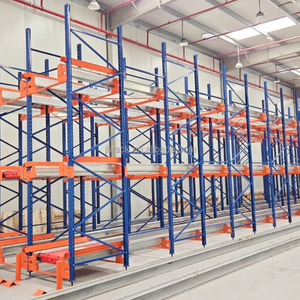
LIFO / FIFO
Payload: 1,500kg
Q355B Steel

No matching pages. Try "pallet", "mezzanine" or "cantilever".
Engineered to replace slow drive-in systems with high-throughput rail-guided automation. Select from 2-way semi-automated runners to 4-way multi-directional deep-lane cold storage carriers.
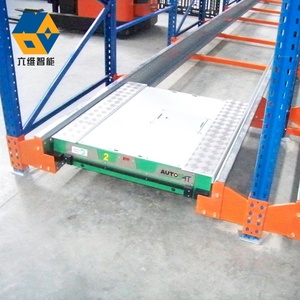
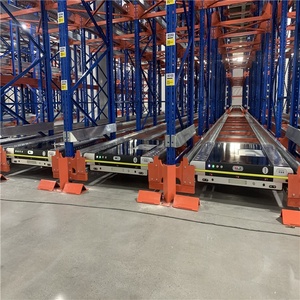
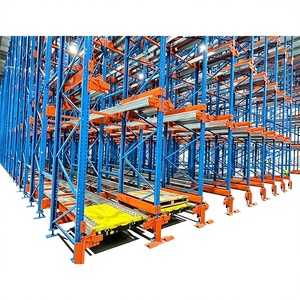
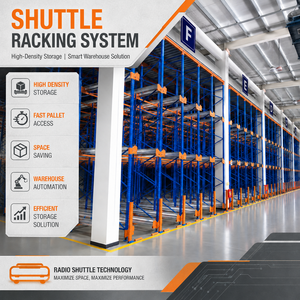
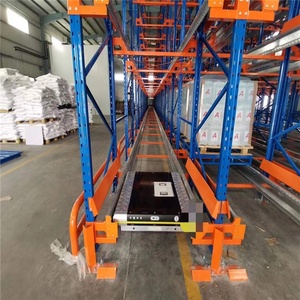
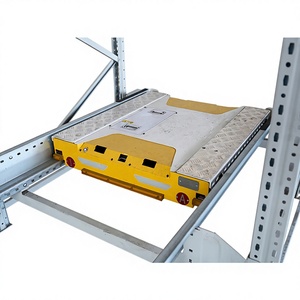
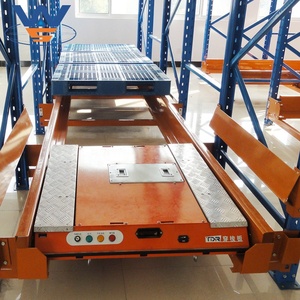
Modern radio shuttle racking systems represent the premier technological middle ground between labor-intensive static pallet racking and multi-million dollar fully automated stacker-crane AS/RS facilities. As a certified custom OEM manufacturer, our structural systems are engineered with precision cold-formed galvanized rails that serve a dual mechanical purpose: carrying the dynamic wheel loads of self-powered radio shuttles while simultaneously bearing static unit pallet loads up to 1,500 kg per position.
By keeping forklifts in the central operating aisle and delegating deep-lane travel to the radio-controlled satellite car, warehouse managers eliminate the structural upright collisions notoriously common in conventional drive-in racking. This architectural shift slashes rack maintenance budgets by over 70% while drastically elevating operator safety under FEM 10.2.02 and EN 15635 standards.
Reinforced 4.0mm heavy gauge zinc-plated lead-in guides guarantee rapid, error-free forklift pallet placement, self-aligning misaligned loads up to ±35mm before shuttle engagement.
Equipped with 48V Lithium Iron Phosphate cells delivering over 8-10 hours of uninterrupted multi-shift duty cycles with zero memory effect and 3-hour rapid docking recharge.
Triple-redundant photoelectric sensors and laser rangefinders calculate cargo clearance distances in real time, preventing pallet impacts and eliminating lost storage space in deep lanes.
Our custom cold rolling lines manufacture proprietary galvanized shuttle rails with integrated tooth rack options for 4-way systems, ensuring zero slip in high-humidity chilled rooms or -30°C deep freeze meat and pharmaceutical facilities.
Contact UsEvaluating pallet density, cycle speeds, capital expenditure, and structural longevity across major industrial storage topologies.
| Storage Topology | Space Utilization | Forklift Cycle Time | Rack Collision Risk | Cold Chain Energy Efficiency | Operational Workflow |
|---|---|---|---|---|---|
| Radio Shuttle System (2-Way) | Very High (80-85%) | Ultra-Fast (Automated Lane) | Minimal (Aisle Only) | Excellent (Dense Volume) | LIFO or FIFO by Lane Design |
| Automatic 4-Way Shuttle Racking | Maximum (>90%) | Continuous Automated | Zero (Fully Automated) | Best in Class | Fully Dynamic FIFO / LIFO Matrix |
| Conventional Drive-In Racking | High (65-75%) | Slow (Driver Enters Lane) | Extreme (High Frame Impact) | Moderate | Strictly LIFO (High Honeycombing) |
| Double Deep Pallet Racking | Moderate (55-65%) | Medium (Special Forklift) | Low-Medium | Fair | LIFO per Double Pair |
| Standard Selective Pallet Racking | Low (35-45%) | Immediate Direct Access | Low (Standard Aisles) | Poor (Massive Wasted Air) | 100% Direct Selective Access |
Global supply chain disruptions, rising warehouse footprint costs, and cold chain expansions are accelerating several structural shifts in shuttle racking procurement.
With cold storage electrical power costs soaring globally, 2-way and 4-way radio shuttle systems are rapidly replacing standard racking. Dense cubic storage compresses refrigeration volume by up to 40%, cutting thermal leakage losses. OEM buyers are prioritizing IP67 electronic enclosures, internal thermal heaters, and low-temperature lithium chemistries rated down to -30°C without battery performance drop.
While 2-way shuttles remain the undisputed king of fast-dock staging and bulk homogeneous storage, enterprise procurement is shifting toward 4-way cross-lane shuttle systems integrated with vertical reciprocating conveyors (lifts). This creates a flexible, scalable AS/RS that achieves complete three-dimensional inventory accessibility without massive fixed stacker crane investment.
Shuttle procurement is no longer just a structural steel buy; it is an industrial IoT integration. Modern buyers demand shuttles with 5G or industrial 433/868/915 MHz Wi-Fi mesh networking. Systems must interface seamlessly with SAP, Manhattan Associates, or proprietary WMS/WCS platforms to deliver live channel slotting, automated pallet rotation, and predictive motor maintenance.
Global exporters must deliver lower shipping freight weights while increasing load tolerances. Shifting from standard Q235B mild structural steel to precision cold-formed Q355B and high-yield European standard micro-alloy steels allows 15% thinner gauges with 30% higher moment capacity, saving significant ocean freight costs and minimizing floor slab seismic anchor loads.
Autonomous Mobile Robots (AMRs) and automated counterbalance forklifts are increasingly executing the aisle transport leg, delivering pallets straight to the entry face of the shuttle rack. Shuttle control units now feature standardized optical docking transponders to execute automatic handshakes with unmanned transport vehicles, creating fully dark warehouse operations.
Corporate insurance underwriters in Europe, the Middle East, and the Americas now mandate third-party structural verification under EN 15512, RMI, and AS4084-2023. Custom OEM suppliers must provide finite element structural calculation dossiers, certified raw material mill test certificates, and traceable installation protocols before commissioning certificates can be issued.
From initial structural calculation and CAD bay layouts to precision continuous cold roll-forming and on-site international installation supervision.
We control high-speed continuous cold roll-forming lines capable of profiling proprietary galvanized guide rails, reinforced omega uprights, and heavy-duty step beams with punching tolerances within ±0.5mm.
All designs follow rigorous structural standards including European EN 15512, FEM 10.2.02, American RMI guidelines, and Australian AS4084 specifications, complete with full seismic loading calculations.
Specialized maritime container bundling using automated steel strapping, impact buffer blocks, and moisture-barrier shrink wrapping prevents maritime corrosion and profile deformation during long ocean journeys.
Drawing from our vast operational project heritage across Dubai, Abu Dhabi, Saudi Arabia, Europe, and the Americas, our certified field engineers provide professional on-site surveying, laser leveling, and anchoring.
State-of-the-art multi-stage pre-treatment and electrostatic epoxy-polyester powder coating lines guarantee a resilient, chip-resistant finish exceeding 500-hour salt spray corrosion testing benchmarks.
Every project concludes with precision laser inspection reports, stamped capacity loading plaques, certified beam locks, and documented safe operation training for warehouse forklift crews.
Direct technical answers addressing floor slab tolerances, cycle capacities, battery operations, and system conversions.
Under EN 15620 and DIN 18202 standards, radio shuttle racking requires a floor flatness rating equivalent to Class 300 or better (typically FF 45 / FL 35 under American ACI 117 standards). Because upright posts carry significant cumulative point loads across deep storage channels, slab thickness must generally exceed 180mm to 250mm of reinforced concrete with minimum compressive strength of C25/30 (25-30 MPa).
Our engineering team performs localized anchor torque analysis and checks floor expansion joints to ensure shuttle channels maintain straight track alignment without pinching the shuttle wheels.
The calculation is driven by hourly throughput targets (pallets in/out per hour) rather than static pallet count alone. In typical operations, one shuttle car services between 500 and 1,500 pallet locations. A single shuttle traveling at 1.0 m/s inside a 25-meter deep lane can achieve approximately 25 to 40 pallet cycles per hour.
For high-turnover fast-moving distribution centers, facilities deploy one shuttle per level or aisle, while seasonal storage facilities with low turnover often share 2 to 4 shuttles across an entire 5,000-pallet facility using forklift repositioning.
In many cases, yes. If the existing upright frames possess verified structural integrity and adequate moment capacity under current EN 15512 codes, the cantilever brackets and continuous drive-in rails can be unbolted and replaced with custom-engineered OEM shuttle guide rail profiles and heavy-duty front landing beams.
Retrofitting eliminates the massive structural impact damage common on drive-in frames, dramatically shortens forklift loading cycles, and frequently yields an immediate 15-20% increase in usable storage height by eliminating clearance allowances required for forklift masts inside storage lanes.
Our OEM shuttle cars feature automated multi-stage voltage threshold monitoring. When the lithium battery drops below 10-12% state-of-charge, the shuttle PLC terminates new storage tasks, emits an audible beacon, and automatically travels to the front aisle face to await battery swapping or docking.
In the highly unlikely event of total power loss mid-channel, our systems ship with an emergency mechanical recovery trolley. The rescue cart is linked to a secondary shuttle or forklift cable to manually engage, unlock the drive brakes, and tow the stalled shuttle back to the aisle face without requiring human entry into the rack tunnel.
Cold storage shuttle models feature hermetically sealed IP65/IP67 electrical housings, internal thermostat-controlled heating pads around the PLC and lithium battery cells, and specialized synthetic low-temperature lubricants that resist viscosity breakdown at -30°C. Furthermore, polyurethane drive wheels with high-durometer compounds are specified to prevent flat-spotting and maintain traction along galvanized cold rails without slip.
Yes. As a custom OEM supplier, we engineer dual-dimension shuttle rails that support both standard Euro pallets (1200 x 800 mm) and Industrial GMA / ISO pallets (1200 x 1000 mm) within the exact same channel. The shuttle car utilizes multiple optical sensor arrays to automatically detect the front and rear edges of different pallet depths, positioning them safely with programmed interstitial clearance gaps.
Share your warehouse CAD drawings, pallet loading specifications, and throughput targets. Our senior logistics engineering team will prepare a comprehensive 3D storage concept layout, cycle-time simulation, and direct OEM factory pricing.